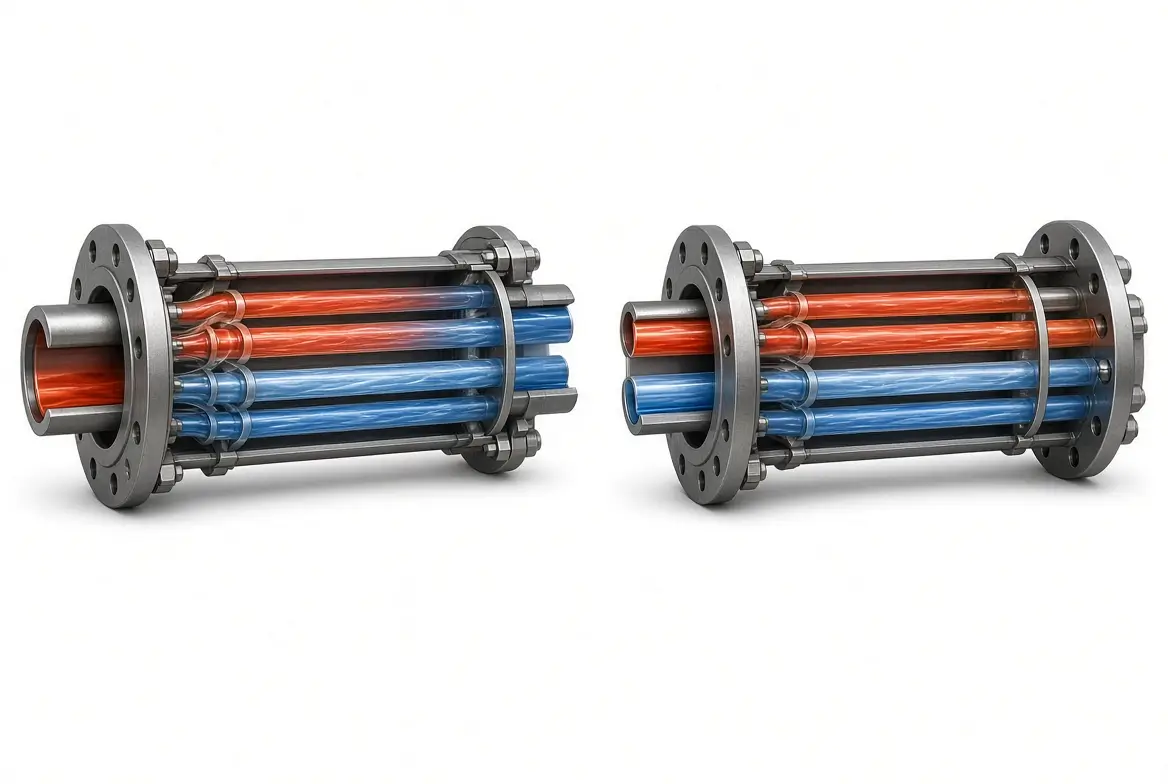
When designing a heat exchanger, one of the first questions engineers often consider is whether the two fluids should flow in countercurrent or co-current (parallel-flow) arrangement.
From a heat-transfer perspective, countercurrent flow is generally more efficient because it can maintain a more favorable temperature difference across the heat exchanger. However, in an actual chemical plant, especially a batch plant, the theoretically optimal flow arrangement is not always the only factor that matters.
If an engineer tries to optimize every modification according to the ideal design pattern, even a relatively simple plant modification can become unnecessarily complicated, time-consuming, and expensive.
In plant maintenance and modification work, there are many situations where you have very little time and need to make the smallest possible change. In such cases, it may be necessary to use a flow arrangement that is not theoretically ideal.
The important point is therefore not simply to remember that “countercurrent is good and co-current is bad.”
It is more useful to understand why countercurrent flow is preferred, what actually changes when co-current flow is used, and how much deviation from the ideal arrangement the plant can tolerate.
This article focuses on the practical engineering perspective, particularly for batch chemical plants.
1. Countercurrent and Co-current Flow in Heat Exchangers
Let’s start with the basic difference.
In a heat exchanger, two fluids exchange heat while flowing through the equipment. The basic difference between countercurrent and co-current flow is simply the direction in which the two fluids move.
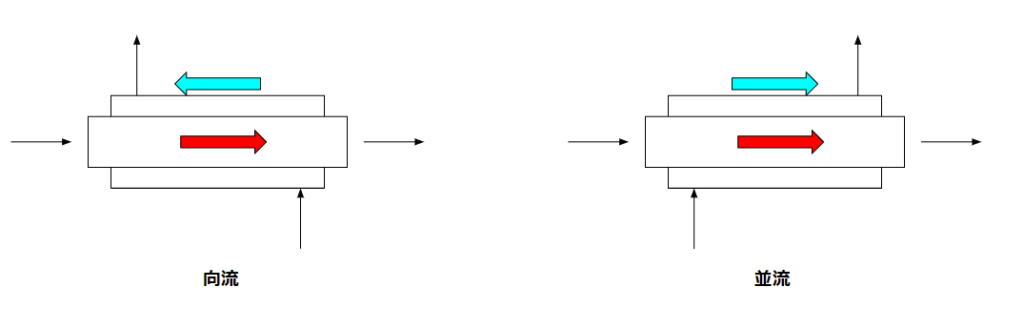
In countercurrent flow, the two fluids move in opposite directions.
In co-current flow, the two fluids move in the same direction.
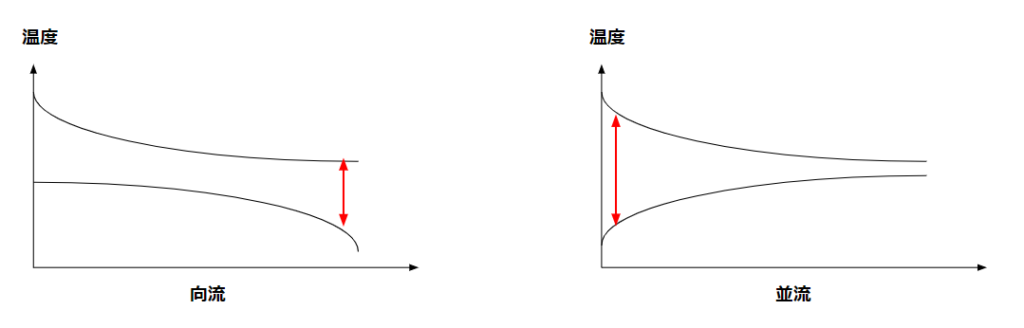
This difference affects the temperature profile inside the heat exchanger.
When a hot fluid and a cold fluid exchange heat, the temperature difference between them changes along the length of the heat exchanger.
With countercurrent flow, the temperature difference tends to be distributed more favorably across the heat exchanger.
With co-current flow, the temperature difference is relatively large at the inlet, but becomes much smaller toward the outlet.
This is one of the fundamental reasons why countercurrent flow is generally preferred for heat-transfer applications.
2. Countercurrent Flow Is Common in Batch Chemical Plants
When comparing countercurrent and co-current flow, countercurrent flow is generally the preferred arrangement in batch chemical plants.
There are several reasons for this.
First, it allows phase changes and changes in physical properties to occur more smoothly throughout the heat exchanger.
Second, some chemical-plant equipment, such as lined equipment, cannot tolerate large local temperature differences.
Third, countercurrent flow allows the heat-transfer surface to be used more effectively.
Batch chemical plants often operate under relatively moderate temperatures, but this does not necessarily mean that temperature effects are insignificant.
A relatively small temperature change can cause evaporation or condensation, while properties such as density and viscosity can also change significantly.
From an equipment standpoint, a large local temperature difference can create a concentrated thermal load and potentially reduce equipment life.
This is particularly important for lined equipment.
For example, a glass-lined vessel or other lined equipment may suffer equipment damage if the temperature difference becomes too large. Countercurrent flow can be advantageous because the temperature difference can be distributed more evenly.
Condensers provide another interesting example.
A heat exchanger used as a condenser may have a section where vapor is condensed and another section where the resulting liquid is cooled. Simply increasing the cooling section does not necessarily make the heat exchanger more effective.
With co-current flow, the temperature difference is initially large, which can change the relative lengths of the condensation and cooling sections.
It may therefore appear attractive to use co-current flow and reduce the required heat-transfer area.
However, batch chemical plants generally require a certain degree of flexibility and robustness.
For this reason, deliberately adopting a special heat exchanger arrangement solely to reduce heat-transfer area is not always a good trade-off.
Some engineers may find this conservative approach frustrating.
However, “robust and predictable” is often more valuable than “theoretically optimal” in chemical plant engineering.
3. Is Co-current Flow Really Bad?
Does this mean that co-current flow should never be used?
No.
This is where the practical engineering perspective becomes important.
When modifying an existing plant, engineers often face situations where the ideal flow arrangement cannot be maintained.
For example, there may be an urgent modification that needs to be completed within a limited shutdown period. Changing the piping completely to achieve the theoretically optimal flow direction may require additional construction work, engineering, procurement, and commissioning time.
At that point, two extreme approaches may appear.
One approach is:
“The original design uses this flow arrangement for a reason, so changing it must be wrong.”
The other is:
“We don’t really know why it was designed this way, but the modification meets the immediate plant requirement, so let’s just do it.”
Neither approach is particularly useful.
In many real-world cases, the answer is somewhere in between.
For example, co-current flow may still be acceptable when:
1. The loss in heat-transfer performance can be compensated for by excess heat-transfer area.
If the original heat exchanger has sufficient design margin, the reduction in performance caused by changing the flow arrangement may not prevent the process from reaching its required temperature.
2. The required outlet temperature has sufficient tolerance.
If the process does not require a very precise temperature, a certain reduction in heat-transfer performance may have little practical impact.
3. Actual operating conditions are already different from the original design conditions.
For example, cooling-water temperatures may have increased since the heat exchanger was originally designed, particularly during summer operation, yet the plant may still be operating satisfactorily.
This third point is particularly important for engineers who are new to heat exchanger design or maintenance.
If you only look at the original design calculation, changing from countercurrent to co-current flow can appear risky.
However, an engineer who has actually observed the equipment operating for many years may know that the system has considerable practical margin.
This does not mean that calculations and design requirements should be ignored.
Rather, it means that design knowledge and actual operating experience should be considered together.
Practical Engineering Perspective
When an unexpected failure or urgent modification makes co-current flow unavoidable, the appropriate response is not simply to reject the modification because it differs from the ideal design.
Instead, the engineer should identify what changes, evaluate the actual operating conditions, and determine whether the remaining margin is sufficient.
The key questions are:
- How much will the heat-transfer performance change?
- Is the required outlet temperature still achievable?
- Is there sufficient heat-transfer area?
- Could the change create an excessive local temperature difference?
- Are there equipment limitations, particularly for lined equipment?
- What happens during the worst operating condition, such as high summer cooling-water temperature?
This approach is especially useful in plant maintenance.
The ideal design arrangement is a better solution in many cases, but “better” does not necessarily mean “mandatory under every circumstance.”
That distinction becomes increasingly important as engineers gain experience with existing plants.
Summary
Countercurrent flow is generally preferred in chemical-plant heat exchangers because it provides a more favorable temperature profile and makes effective use of the heat-transfer surface.
For batch chemical plants, countercurrent flow is particularly attractive because phase changes, physical-property changes, equipment temperature limitations, and the need for robust operation all have to be considered.
However, this does not mean that co-current flow is automatically unacceptable.
In plant modifications, the real question is often whether the loss in heat-transfer performance is significant enough to affect actual operation.
If sufficient heat-transfer area remains, the required temperature has some tolerance, and actual operating conditions provide adequate margin, a co-current arrangement may still work adequately.
Therefore, engineers should avoid both extremes: blindly following the original design and blindly ignoring it.
The practical skill is to understand why the ideal arrangement is preferred and then determine how much deviation the actual plant can tolerate.
In chemical plant engineering, the theoretically best solution is not always the most practical solution. Especially during maintenance and modification work, understanding the difference between “better” and “necessary” can make a significant difference in engineering decisions.
About the Author – NEONEEET
A user‑side chemical plant engineer with 20+ years of end‑to‑end experience across design → production → maintenance → corporate planning. Sharing practical, experience‑based knowledge from real batch‑plant operations. → View full profile



Comments