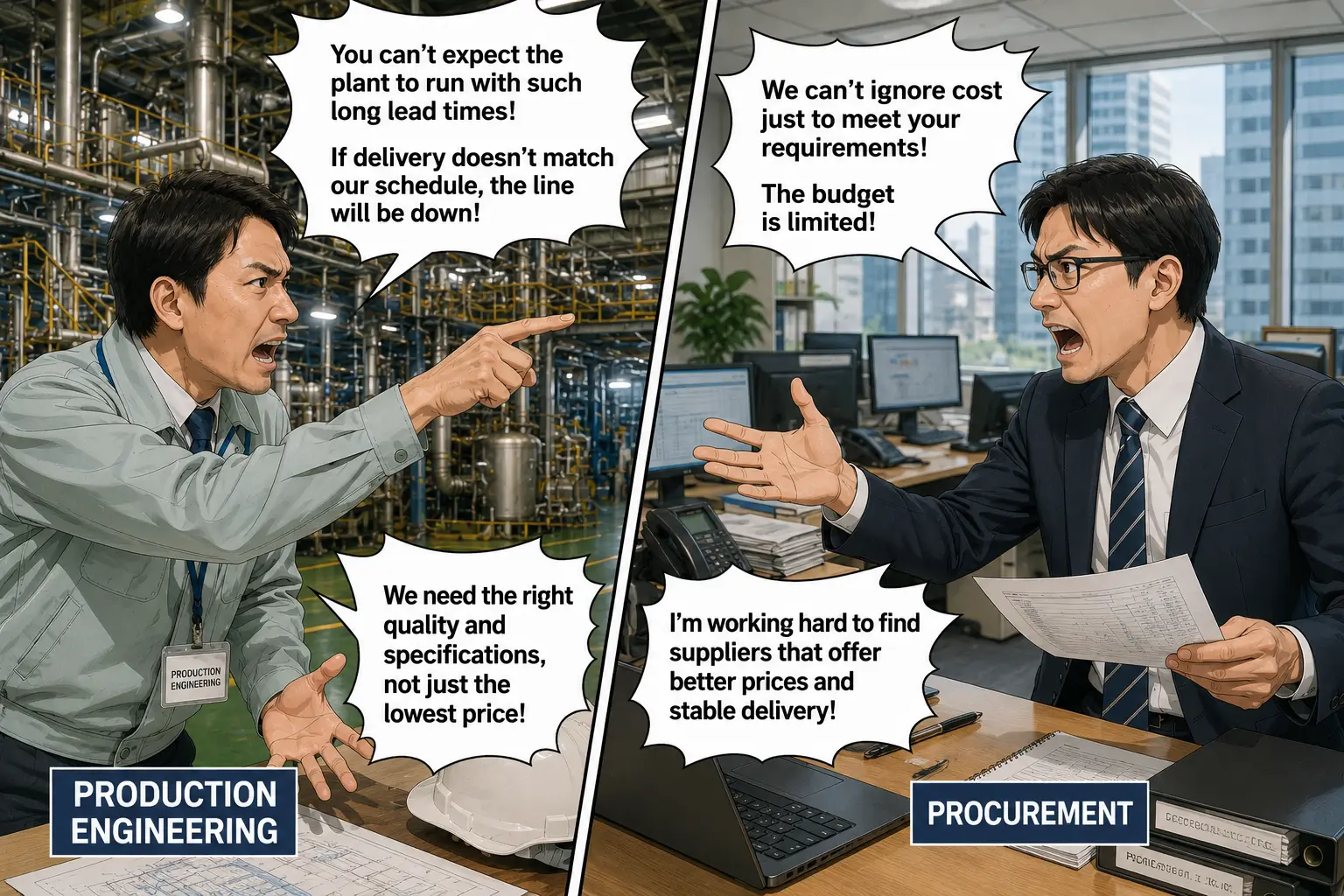
The relationship between procurement and production engineering is a frequent source of friction in manufacturing companies, particularly in large, traditional Japanese corporations.
Chemical plants are no exception.
I have spent more than 20 years working for a chemical company, including more than 15 years in engineering roles that required close interaction with procurement. Over that time, my view of procurement has changed considerably.
When I was a junior engineer, I simply followed procurement procedures without thinking too much about the role of the procurement organization. As I gained experience with increasingly complex equipment and projects, however, I began to notice a fundamental difference between how production engineers and procurement professionals view the same project.
This article looks at that relationship from the perspective of a chemical plant production engineer.
The purpose is not to argue that production engineering is right and procurement is wrong. Rather, it is an account of how the relationship changed over roughly 20 years and why the two organizations can gradually become disconnected.
Early Career: Procurement Was Simply Part of the Process
During my first few years, I did not have a particularly strong opinion about procurement.
I was still learning how chemical plants worked, and my priority was simply to complete whatever task had been assigned to me as quickly as possible.
Procurement-related work was relatively easy to understand because the process was straightforward: prepare a purchase request, obtain quotations, complete the necessary evaluation, place the order, and wait for delivery.
As a junior production engineer, I frequently handled purchase requests and delivery-related tasks.
At that stage, however, I did not understand much about procurement itself.
I did not know how much material was normally purchased, how suppliers were selected, what constraints procurement had, or how procurement viewed its relationship with suppliers.
I simply followed instructions from procurement and asked my supervisors or colleagues whenever something was unclear.
I was basically a machine.
The items I frequently purchased included ball valves and glass-lined piping.
By repeatedly looking through supplier catalogs as part of the actual purchasing process, I gradually developed a better understanding of these materials.
I Thought Good Relationships Would Lead to Cooperation
At that time, I believed that if you built a good relationship with another department, that department would help you when you really needed it.
In some cases, that actually happened.
Procurement staff did cooperate with me when I had an urgent request, and I assumed that this was because we had established a good working relationship.
Looking back, however, the situation may have been much simpler.
The equipment I was purchasing was relatively standardized, and the procurement process itself was not particularly complicated.
In other words, I may have mistaken an easy transaction for a strong organizational relationship.
Unrealistic Delivery Requests
As a new employee, I also made plenty of unreasonable delivery requests.
This was about 20 years ago, when suppliers and procurement departments were generally more willing to accommodate aggressive schedules.
Sometimes the schedule was unrealistic from the beginning.
Sometimes I had simply delayed my own work and then suddenly needed the equipment.
There were also cases where I made arrangements before properly consulting procurement.
It was not particularly good practice, but it was part of my learning process as a young engineer.
Middle Career: My View of Procurement Changed
As I became more experienced, I started purchasing specialized equipment rather than standardized components.
This was when my perception of procurement changed significantly.
The issues became much closer to the commonly discussed conflict between production engineering and procurement.
Procurement Set Deadlines Without Consulting Engineering
When I submitted a purchase request, procurement often established various deadlines without consulting the engineering side.
For example:
- Quotation deadline
- Technical evaluation deadline
- Purchase order date
- Drawing submission date
The problem was that the engineering side often knew only the required delivery date.
We did not necessarily know when the quotations would arrive, how much time we would have for technical evaluation, or when the purchase order would actually be issued.
That made it difficult to plan our workload.
Sometimes a quotation arrived, I completed the technical evaluation the following day, and then procurement took more than two weeks to place the order.
From my perspective, I had worked late to meet the deadline, while procurement did not appear to have the same sense of urgency.
Naturally, I became frustrated.
The same problem occurred with purchase orders and drawing submissions.
Sometimes I did not know when the order had actually been placed until the supplier contacted me directly.
At other times, procurement had told the supplier that the schedule would slip slightly without informing the engineering side.
Eventually, we started holding coordination meetings with procurement before major purchases and sharing schedules and project information in advance.
This helped to some extent.
However, another problem appeared.
Once procurement had established a fixed schedule, they became reluctant to accommodate changes requested by the production engineering side.
The system became more organized, but also more rigid.
Procurement Did Not Always Manage the Actual Progress
Another major source of frustration was progress management after the purchase order had been issued.
To be fair, procurement’s primary responsibility was generally to manage the overall commercial relationship, including cost and contractual delivery dates.
Procurement also received regular reports from suppliers.
However, in my experience, those reports were not always examined deeply enough, and important information did not always reach the engineering team.
The supplier might report that everything was progressing according to plan, while the engineering team was having completely different discussions with the supplier.
The supplier could also describe problems in a relatively vague way when reporting to procurement.
As a result, the project could appear to be progressing normally from the procurement side even though engineering was already aware of potential problems.
When the problem eventually became serious, procurement would become involved.
However, I sometimes heard responses such as:
“Production engineering should have contacted the supplier more frequently as well, shouldn’t they?”
or:
“There is no other option now. Please adjust the schedule within the plant.”
After experiencing this repeatedly, my trust in procurement declined considerably.
This was particularly problematic for custom-built equipment such as stainless-steel fabricated equipment, centrifuges, and powder-processing equipment such as dryers.
The larger the project value and the more unique the design, the greater the risk.
Because these types of equipment are not purchased frequently, it is also difficult for different organizations to share a common understanding of how the project should be managed.
I was also told several times that engineering inspections and drawing reviews were taking too long, particularly when dealing with large suppliers.
Procurement Looks at the Overall Relationship; Engineering Looks at One Project
I think one of the biggest differences between procurement and production engineering is the scope of the relationship they are managing.
Procurement tends to look at the overall business relationship.
Production engineering tends to look at one specific project.
For example, procurement may have several projects running simultaneously with the same supplier.
From procurement’s perspective, the supplier relationship needs to be considered across all of those projects.
From the production engineer’s perspective, however, there is usually one specific piece of equipment that must arrive on time and work correctly.
If one project has a problem with cost, delivery, or quality, the engineer naturally wants that problem solved immediately.
Procurement may instead consider the impact of that decision on other ongoing projects with the same supplier.
This is understandable.
The problem is that the production engineer often cannot see that larger picture.
At the same time, procurement may not fully understand the operational consequences of a delay in one particular piece of equipment.
That difference in perspective can create significant friction.
Negotiation as a Procurement Performance Target
Another issue is how procurement performance is measured.
In many organizations, procurement is evaluated partly on how much the final contract price is reduced compared with the initial budget or quotation.
I understand why companies use this kind of metric.
Procurement needs measurable targets, and cost reduction is relatively easy to quantify.
However, I have often felt that this metric can become disconnected from the actual value of the project.
The initial budget may have been prepared by production engineering.
It may already include allowances for inflation, historical costs, market conditions, and other uncertainties.
The final price, meanwhile, depends on market conditions and the supplier’s situation at the time of contracting.
If procurement spends too much time negotiating a relatively small price reduction, the project schedule can suffer.
There were cases where the contract had not yet been finalized, but procurement told us to proceed based on an informal commitment because the engineering work could not wait.
From the production engineering side, this created the impression that procurement was prioritizing its own KPI over the project.
That perception can become very difficult to reverse.
Procurement That Has Little Connection to the Plant
Another issue was the distance between procurement and the actual manufacturing site.
In my experience, procurement was not always a popular department within the chemical company.
There were frequent personnel changes, and the department often seemed understaffed.
The company also increasingly hired people who had never worked at a chemical plant.
This creates a difficult situation.
Procurement in a chemical company is not really a “chemical” job.
It is heavily focused on equipment, suppliers, contracts, and commercial processes.
For someone without a plant engineering background, it can be difficult to understand why a particular valve, piece of equipment, or supplier matters so much to plant operation.
Over time, I also heard suppliers say things such as:
“Your procurement department is very demanding.”
It is a polite expression, but from the engineering side it can sometimes be interpreted as criticism that procurement is focusing too heavily on price.
When procurement rarely visits the plant and mainly communicates information from headquarters to the factory, it becomes difficult to imagine that the organization has a strong emotional or operational connection to the plant.
Later Career: Procurement and Long-Term Plant Operation
As my career progressed, my concerns changed again.
Earlier in my career, my frustration was mainly about individual projects.
Later, I became more concerned about whether procurement understood the long-term operation of the entire plant.
Equipment Selection and Long-Term Maintenance
For a chemical plant that is expected to operate for decades, maintenance philosophy is extremely important.
Engineers who have worked with the same plant for many years naturally begin to think about standardization.
For example, when an aging plant starts experiencing more equipment failures, standardization of equipment specifications can become extremely valuable.
Using the same or similar equipment can simplify:
- Spare parts management
- Maintenance procedures
- Operator training
- Troubleshooting
- Vendor support
- Emergency repairs
From the engineering side, this can be an important plant-wide strategy.
However, trying to explain this philosophy one project at a time to procurement does not always work.
From procurement’s perspective, they may reasonably think:
“If this is an important company-wide policy, shouldn’t it be decided at the appropriate organizational level rather than being imposed on individual purchasing projects?”
That is actually a reasonable argument.
The problem is that if no organization is responsible for connecting the two perspectives, the plant-level strategy never reaches procurement.
The result is that procurement optimizes each transaction while engineering tries to optimize the plant.
Strong Resistance to Single-Source Procurement
Procurement organizations naturally tend to be cautious about single-source purchasing.
Obtaining competitive quotations helps maintain transparency, commercial competitiveness, and internal controls.
I understand that.
However, specialized equipment does not always fit neatly into a competitive bidding model.
For example, consider two suppliers, Company A and Company B.
A simple justification might once have been:
“Company A has extensive experience with this equipment and can meet the required delivery date.”
Today, the justification might have to be much more detailed:
“Company A has significantly more past failures and poorer service performance than Company B. Company B has demonstrated better maintenance performance and provides advantages in the manufacturing process that contribute to production stability. Since our plant already has a high concentration of equipment from Company A, maintaining a certain share with Company B will also improve maintenance flexibility.”
Once a justification like this is submitted, procurement may ask for additional documentation.
What were the past failures?
Can you provide a failure history?
Which projects had maintenance problems?
Wouldn’t standardization actually make maintenance easier?
These are reasonable questions individually.
The problem is that the engineering team may have only a short period before the quotation or evaluation deadline.
Procurement may request extensive historical data while simultaneously setting tight deadlines for the engineering team.
In some cases, procurement already knows about the historical problems, but the information was lost when personnel changed.
The engineering team is then asked to recreate information that effectively existed somewhere else within the company.
This is particularly difficult in large organizations.
The Distance Between Procurement and Production Engineering Matters
After more than 20 years, I have become convinced that procurement and production engineering should not be organizationally or physically isolated from each other.
In my case, procurement was based at headquarters while production engineering was based at the plant.
The plant had its own operating philosophy, and that philosophy was relatively well understood inside the plant.
However, communicating that philosophy to headquarters was much more difficult.
The difference becomes particularly obvious when comparing procurement with other headquarters functions.
Some headquarters departments actively communicate with the plant and try to understand its situation.
Procurement, in my experience, was one of the departments where that connection was weaker.
I now believe that having procurement and production engineering physically and organizationally closer can provide significant benefits.
For example, it becomes easier to discuss small issues immediately.
Procurement and engineering can attend supplier meetings together.
Regular progress meetings can also be organized much more easily.
These small interactions can prevent major misunderstandings later.
Conclusion
After more than 20 years in the chemical industry, my view of procurement has changed considerably.
When I was young, I simply thought of procurement as another department that processed purchase orders.
After working on increasingly complex projects, however, I came to understand that production engineering and procurement are looking at fundamentally different things.
Production engineering tends to think about “how we will continue operating and maintaining this equipment,” while procurement tends to think about “how the company should manage its relationship with suppliers.”
Neither perspective is inherently wrong.
The problem is that if these two perspectives are not actively connected, they naturally drift apart.
Production engineers may begin to see procurement as an obstacle.
Procurement professionals may begin to see production engineering as a department that makes unreasonable requests.
Once that relationship develops, every individual project becomes harder.
For chemical plants in particular, where equipment may remain in service for decades, procurement and production engineering should be much closer partners.
The goal should not be for one department to win an argument against the other.
It should be for both sides to understand what the other is trying to optimize.
About the Author – NEONEEET
A user‑side chemical plant engineer with 20+ years of end‑to‑end experience across design → production → maintenance → corporate planning. Sharing practical, experience‑based knowledge from real batch‑plant operations. → View full profile



Comments