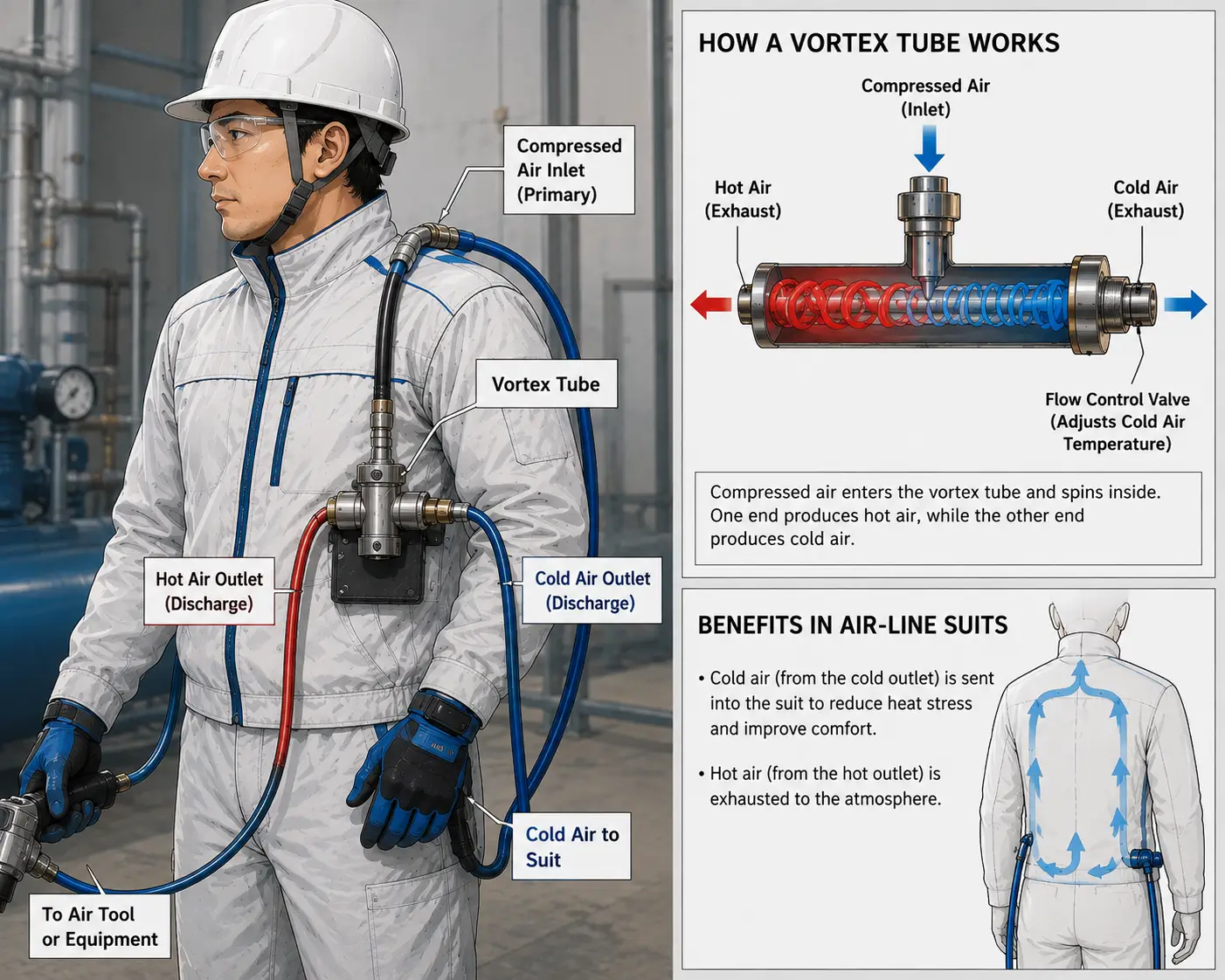
A vortex tube is a fascinating device that can produce cold air using only compressed air. For a time, I considered whether this technology could be applied in a chemical plant.
That kind of evaluation is particularly interesting because a technology that works well in general applications may present completely different challenges when introduced into a chemical plant.
One potential application is cooling an air-line suit used by workers in hot areas where chemical exposure protection is required.
A vortex tube can certainly provide cold air without refrigeration equipment. However, the cooling performance itself is not the only factor that matters.
When considering a vortex tube for use in a chemical plant, several practical issues need to be examined, including airflow capacity, the compressed-air system, mounting, hot-air discharge, and overall worker safety.
Improving the Working Environment
A vortex tube separates compressed air into cold and hot streams. The actual operating principle is quite complicated, but understanding every detail of the physics is not necessarily required for practical application.
The important point is that it can produce cold air without electricity.
This makes the technology attractive for improving working conditions, particularly in hot environments where heat stress is a concern.
Vortex tubes are manufactured by various companies. For example, Japanese manufacturer Kogi provides vortex tube products for industrial applications.
Kogi Corporation – Vortex Tube / Vortex Cooler
Chemical plants sometimes require workers to wear air-line suits to protect them from exposure to chemicals.
These suits can also be used in outdoor or otherwise unconditioned areas where there is no enclosed air-conditioning system. During summer, this can create a significant heat-stress risk.
An air-line suit supplies air inside the suit, so compressed air is already required.
However, compressed air can be warmer than the surrounding atmosphere, particularly after compression and distribution through the plant utility system. If this air is supplied directly to the suit, the worker may still be exposed to considerable heat.
A refrigeration system or heat exchanger could be used to cool the compressed air, but installing dedicated cooling equipment can become expensive and complicated.
A vortex tube therefore appears attractive because it can potentially provide cooling using the compressed-air supply that is already available.
However, this is where the practical considerations begin.
The Available Airflow Can Be Reduced
One of the most important characteristics of a vortex tube is that it divides the incoming compressed air into cold and hot streams.
In other words, not all of the inlet air becomes the cold air that is supplied to the air-line suit.
As a simple conceptual example, if the cold-air and hot-air streams were approximately 1:1, only about half of the inlet flow would become the cold-air stream.
The actual ratio depends on the vortex tube and operating conditions, so this should not be treated as a universal design value. Nevertheless, the basic concept is important: adding a vortex tube does not simply provide cooling while maintaining the same usable airflow.
This can create several problems.
For example, if the compressed-air supply capacity is insufficient, the airflow supplied to the air-line suit may fall below the required level.
That is not merely a comfort issue. Depending on the type of air-line suit and its intended protection, insufficient airflow could compromise the protective function and potentially create a serious safety problem.
Another concern is the effect on the rest of the compressed-air system.
If additional compressed air is consumed to maintain the required airflow to the suit, the increased demand could affect other users connected to the same utility system. In particular, pneumatic control valves and other instruments may be affected if the available air pressure or flow becomes insufficient.
The exact risk depends on how the plant air system is configured, but the principle remains the same.
Compressed-air systems are often among the more difficult plant utilities to understand because many different users are connected to the same network.
Therefore, a vortex tube should not be evaluated as an isolated piece of equipment. The entire compressed-air system needs to be considered.
Mounting the Vortex Tube Can Be Difficult
Another practical problem is how to mount the vortex tube.
Vortex tubes are generally small and lightweight. From a cooling and operating perspective, it may seem reasonable to install the device close to the air-line suit so that the cold air travels only a short distance and the worker can adjust the operating conditions.
However, an air-line suit is relatively large and can significantly restrict the user’s field of view.
This makes it difficult for the worker to confirm whether the vortex tube and its connections remain securely attached during work.
If the vortex tube becomes detached or its connection is damaged, the air-line suit may no longer function as intended.
Even more importantly, a sudden change in the air supply could cause the worker to panic, particularly while working in an area where chemical exposure is possible.
A mounting arrangement that looks mechanically simple during design can therefore become a significant operational risk in the actual work environment.
For this reason, I would be cautious about directly attaching a vortex tube to an air-line suit.
The issue is not whether the vortex tube itself is reliable. The issue is whether the entire system remains safe and functional while a worker is wearing the suit and performing actual work.
The Hot-Air Stream Can Also Be Dangerous
There is another important characteristic that should not be overlooked.
A vortex tube produces both cold air and hot air.
The hot-air stream can reach a considerably higher temperature than the compressed-air inlet.
This creates a potential burn hazard.
It can also create an equipment-damage problem if the vortex tube is mounted directly on an air-line suit.
For example, if the hot-air outlet is positioned close to the suit material, the material could potentially be exposed to excessive heat and become damaged.
This is particularly concerning because the worker may have difficulty seeing the vortex tube while wearing the suit.
In other words, a device intended to improve the working environment could actually make the overall work situation more complicated if the hot-air outlet, mounting arrangement, or hose routing is not properly considered.
This is a good example of why equipment selection in a chemical plant cannot be based solely on the performance of the individual device.
Conclusion
A vortex tube is an attractive technology because it can generate cold air from compressed air without requiring a refrigeration system.
For applications such as cooling an air-line suit in a chemical plant, this could potentially provide a relatively simple way to improve the working environment without installing additional refrigeration equipment.
However, the cold-air temperature is only one part of the problem.
Before adopting a vortex tube, it is important to consider the reduction in usable airflow, the impact on the compressed-air system, the mounting arrangement, the hot-air discharge, the possibility of burns or equipment damage, and the worker’s ability to safely operate while wearing the suit.
I personally find it interesting to consider whether new technologies can be applied to chemical plants. However, there is an important distinction between a technology being technically applicable and the entire system being safe and practical in an actual plant environment.
If a vortex tube is considered for a chemical-plant application, the question should therefore not simply be:
“Can it produce cold air?”
The more important question is:
“Can the entire system operate safely and reliably under actual working conditions?”
That broader perspective is essential when introducing unfamiliar technologies into chemical plants.
About the Author – NEONEEET
A user‑side chemical plant engineer with 20+ years of end‑to‑end experience across design → production → maintenance → corporate planning. Sharing practical, experience‑based knowledge from real batch‑plant operations. → View full profile



Comments