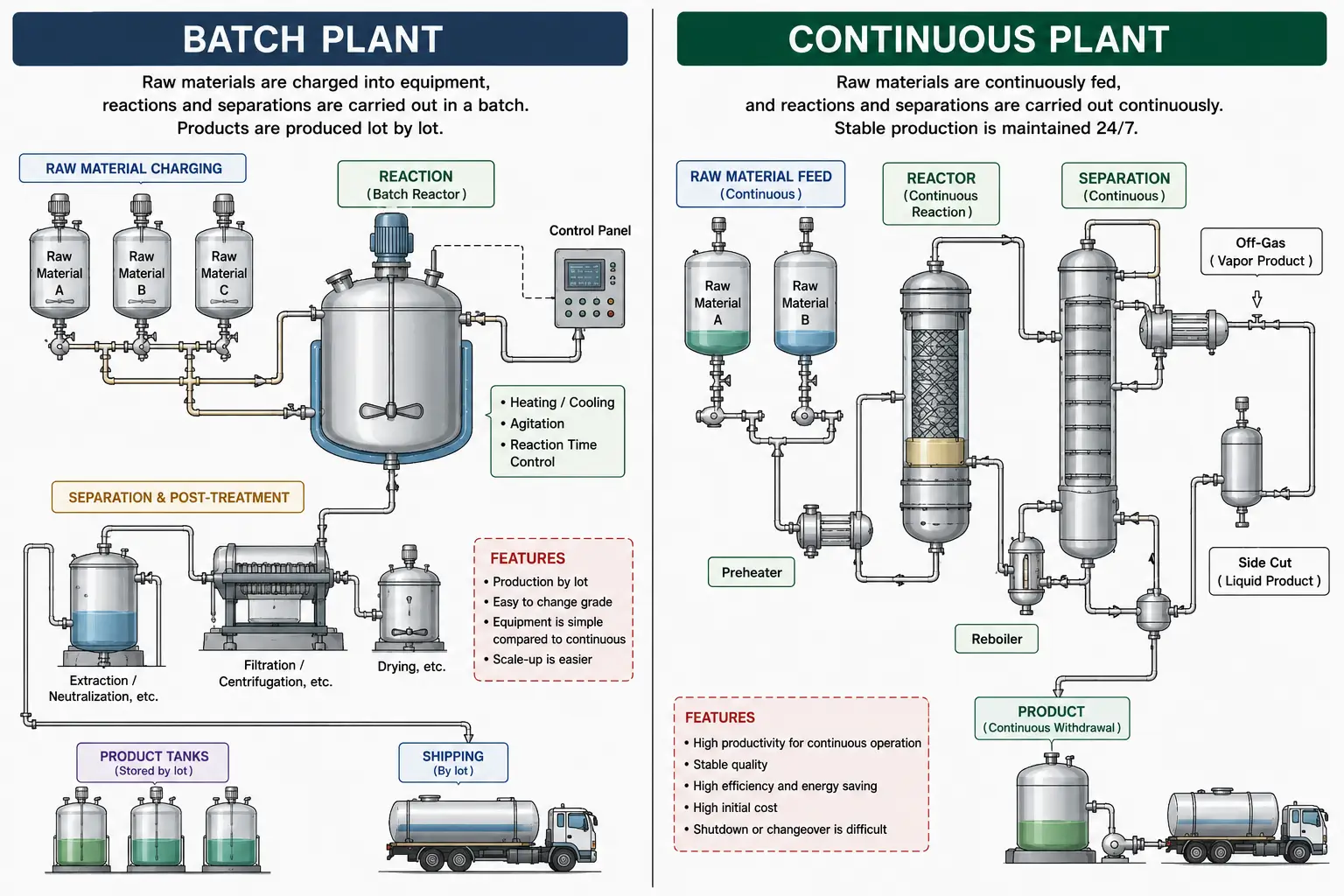
Chemical plants are generally classified into two major production methods: batch plants and continuous plants.
Although both belong to the chemical process industry, they differ significantly in equipment design, operating philosophy, and maintenance strategy. Many engineers spend their careers working in only one type of plant, making it difficult to understand the characteristics of the other.
During more than 20 years in the chemical industry, I have worked exclusively with batch plants. For me, batch processing feels natural, while continuous processing appears unique. For many engineers around the world, however, the opposite is true.
Comparing these two production methods is one of the easiest ways to understand how each plant is designed and operated. Even if your career focuses on only one type, understanding the other broadens your engineering perspective.
This article compares batch and continuous plants from three practical viewpoints:
- Equipment
- Plant operation
- Maintenance philosophy
Batch Plant vs Continuous Plant Comparison
There are many ways to compare batch and continuous plants. The following table summarizes the most common characteristics. Individual facilities may differ, but these are generally accepted engineering trends.
| Continuous Plant | Batch Plant |
|---|---|
| High-volume, low-mix production | Low-volume, high-mix production |
| Tall process units and columns | Rectangular buildings housing reactors |
| Distillation columns as major equipment | Reactors as major equipment |
| Stainless steel equipment | Glass-lined reactors are common |
| More static equipment | More rotating equipment |
| Highly automated | More manual operations |
| Occasional sampling | Sampling almost every batch |
| PID control dominant | Sequential control dominant |
| Limited working space | Larger working areas |
| Keep the plant running whenever possible | Plant shutdowns are acceptable |
| Major shutdown every several years | Planned shutdown almost every year |
| Higher temperature and pressure | Often near ambient conditions |
The production philosophy itself—continuous production for commodity chemicals versus batch production for specialty chemicals—is another important topic but is beyond the scope of this article.
The following sections explain the engineering differences in more detail.
Equipment Characteristics
The most obvious difference lies in the primary process equipment.
Continuous plants are typically built around distillation columns, absorbers, and other large process towers. Their tall structures create the familiar skyline seen in refineries and petrochemical complexes.
Batch plants, on the other hand, are centered on reactors. Since reactors are usually installed inside buildings, batch plants often appear as simple rectangular structures from the outside.
Another notable difference is the construction material.
Continuous plants commonly use stainless steel equipment because of its strength and durability.
Batch plants frequently employ glass-lined reactors, which provide excellent corrosion resistance for specialty chemicals and multipurpose production. Engineers who have only worked in continuous plants are often surprised by how common glass-lined equipment is in batch facilities.
Equipment composition also differs.
Continuous plants contain a larger proportion of static equipment, while batch plants rely heavily on rotating equipment, especially agitators installed on reactors.
Operational Characteristics
The operating philosophy differs considerably.
Continuous plants are designed for stable 24/7 production with extensive automation.
Batch plants also automate the core chemical process, but manual work remains common during raw material charging, product discharge, packaging, and cleaning operations.
Quality control is another major difference.
Because every batch represents an individual production lot, process sampling is performed much more frequently. In many facilities, samples are collected once or multiple times during every batch.
Control philosophy also changes.
Continuous plants primarily rely on PID control to maintain stable process variables.
Batch plants use much more sequential control, where operations proceed step-by-step according to predefined recipes. Both control methods exist in either type of plant, but their relative importance is quite different.
Since operators perform more manual work, batch plants generally provide wider working spaces and temporary storage areas for raw materials and finished products.
Maintenance Characteristics
Maintenance philosophy is where the differences become especially clear.
Continuous plants prioritize maximum uptime. Even a short unplanned shutdown can result in significant production losses because restarting the entire process often requires considerable time.
Batch plants offer greater operational flexibility. Since stopping and restarting production carries less risk, operators can shut down equipment when necessary to address mechanical issues.
Shutdown maintenance also differs.
Continuous plants often perform major turnarounds every several years.
Batch plants commonly conduct smaller scheduled shutdowns every year, allowing maintenance work to be distributed over shorter intervals.
Operating conditions also influence maintenance requirements.
Continuous plants frequently operate under high temperatures and pressures, increasing mechanical stress on equipment and making preventive maintenance essential.
Batch plants generally operate under milder conditions, but glass-lined equipment requires specialized handling. While these reactors provide excellent corrosion resistance, they are more vulnerable to mechanical damage than stainless steel equipment.
Consequently, maintaining a batch plant is not necessarily easier—it simply requires different knowledge and maintenance practices.
Conclusion
Batch and continuous plants differ far beyond their production methods.
Their equipment configurations, operating philosophies, process control strategies, and maintenance approaches are all fundamentally different.
Understanding these differences helps engineers:
- Better understand unfamiliar process plants
- Communicate more effectively across different industries
- Make better engineering decisions during design, operation, and maintenance
Whether you work in batch processing or continuous manufacturing, learning the strengths of both systems will make you a more versatile chemical plant engineer.
About the Author – NEONEEET
A user‑side chemical plant engineer with 20+ years of end‑to‑end experience across design → production → maintenance → corporate planning. Sharing practical, experience‑based knowledge from real batch‑plant operations. → View full profile



Comments