
In chemical plants, nitrogen blow is commonly used during liquid transfer and piping cleaning. In batch operations, pumps alone cannot remove all liquid from the system, so nitrogen is used to push the remaining liquid through the line.
This article explains the three typical nitrogen blow patterns used in batch chemical plants and highlights key safety considerations for each method.
Liquid Transfer with Nitrogen Blow
A nitrogen blow refers to introducing nitrogen gas into a pipeline to push out the remaining liquid. In general machinery, compressed air may be sufficient. However, in chemical plants, nitrogen is used to prevent the formation of explosive atmospheres when handling flammable liquids.
Some process liquids must not remain stagnant during operation. In batch plants, unavoidable downtime exists between steps. Nitrogen blowing helps prevent liquid stagnation during these intervals.
The same principle applies during equipment cleaning, particularly during product changeovers or shutdowns.
The Pump Limitation
Pumps are the primary means of liquid transfer in chemical plants. However, one major limitation is that pumps cannot run dry.
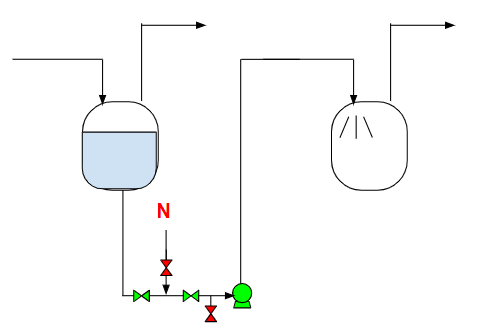
When attempting to transfer the full volume, residual liquid often remains in low sections of piping. This is where nitrogen blow becomes necessary.
After transferring most of the liquid by pump and stopping it, three main nitrogen blow approaches are typically considered.
1. Blow Toward the Receiving Tank (Downstream Blow)
This is the most common method.
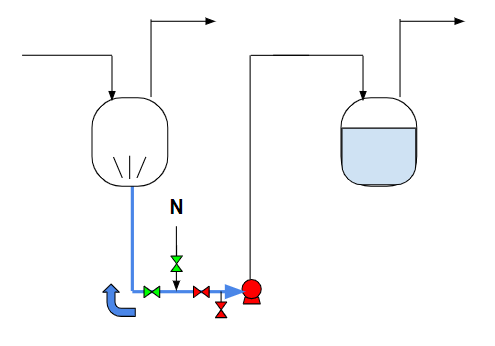
After stopping the pump:
- Close the valve on the source tank.
- Open the nitrogen valve.
- Ensure the receiving tank’s vent or gas outlet is open.
Liquid and nitrogen flow into the receiving tank. Improper venting—especially in systems with automated valves—can cause operational issues.
2. Blow Back Toward the Source Tank (Upstream Blow)
This is the reverse approach.
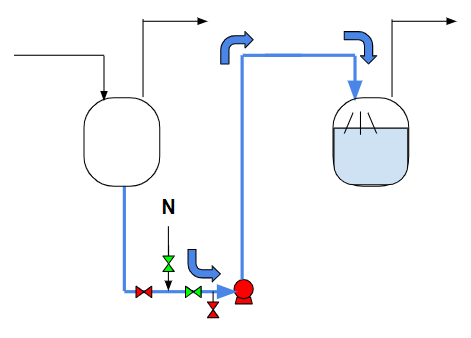
Valve operation differs from downstream blowing. It is often used during phase separation operations and can also function as nitrogen purging or bubbling.
This method is less common for full-volume transfer but useful in specific operational contexts.
3. Pressure Transfer (Tank Pressurization)
Another full-transfer method is pressurizing the source tank by introducing nitrogen into the tank headspace.
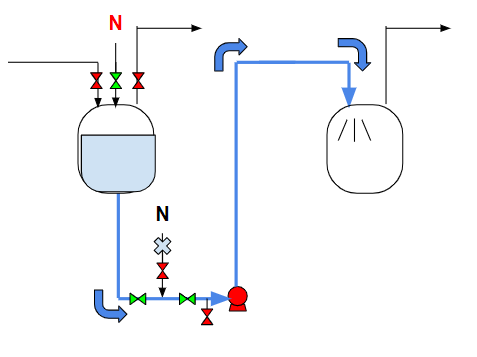
Key points:
- All tank inlet and gas lines must be properly closed.
- The tank becomes pressurized, which introduces safety risks.
A tank normally designed for atmospheric use may require pressure vessel classification if routinely pressurized by nitrogen.
Extreme caution is required if nitrogen is connected both to the tank top and bottom. If valves are improperly aligned, process liquid can backflow into the nitrogen system, potentially contaminating the entire plant nitrogen network.
Limitations of Nitrogen Blow
Nitrogen blow is not perfect. Its limitations must be clearly understood.
Residual Liquid in Horizontal Piping
Even after nitrogen blowing, liquid can remain in horizontal piping.

When the pipe is fully filled, nitrogen pressure pushes liquid forward. As liquid volume decreases, a gas channel forms. At that point, nitrogen bypasses the remaining liquid rather than pushing it out.
Stopping nitrogen temporarily to allow liquid pooling, then reapplying pressure, can sometimes improve recovery.
Installing a pressure gauge helps operators identify when gas breakthrough occurs.
Special Caution with Slurries
Nitrogen blow requires particular care when handling slurries (liquid-solid mixtures).

Gas pressure may move liquid preferentially, leaving solids behind. Since solids are often the product, incomplete transfer can cause yield loss and operational issues.
In slurry systems, liquid flushing is typically performed first, followed by nitrogen blow as a final step.
Conclusion
The three basic nitrogen blow patterns are:
- Downstream blow (to receiving tank)
- Upstream blow (to source tank)
- Pressure transfer (tank pressurization)
In batch chemical plants, nitrogen blow is essential when pumps alone cannot complete liquid transfer.
However, operators must understand:
- Liquid may remain in horizontal piping
- Slurry systems require special handling
- Tank pressurization introduces safety and regulatory considerations
When properly applied, nitrogen blow helps reduce chemical loss and prevent equipment trouble while maintaining safe operation.
About the Author – NEONEEET
A user‑side chemical plant engineer with 20+ years of end‑to‑end experience across design → production → maintenance → corporate planning. Sharing practical, experience‑based knowledge from real batch‑plant operations. → View full profile



Comments