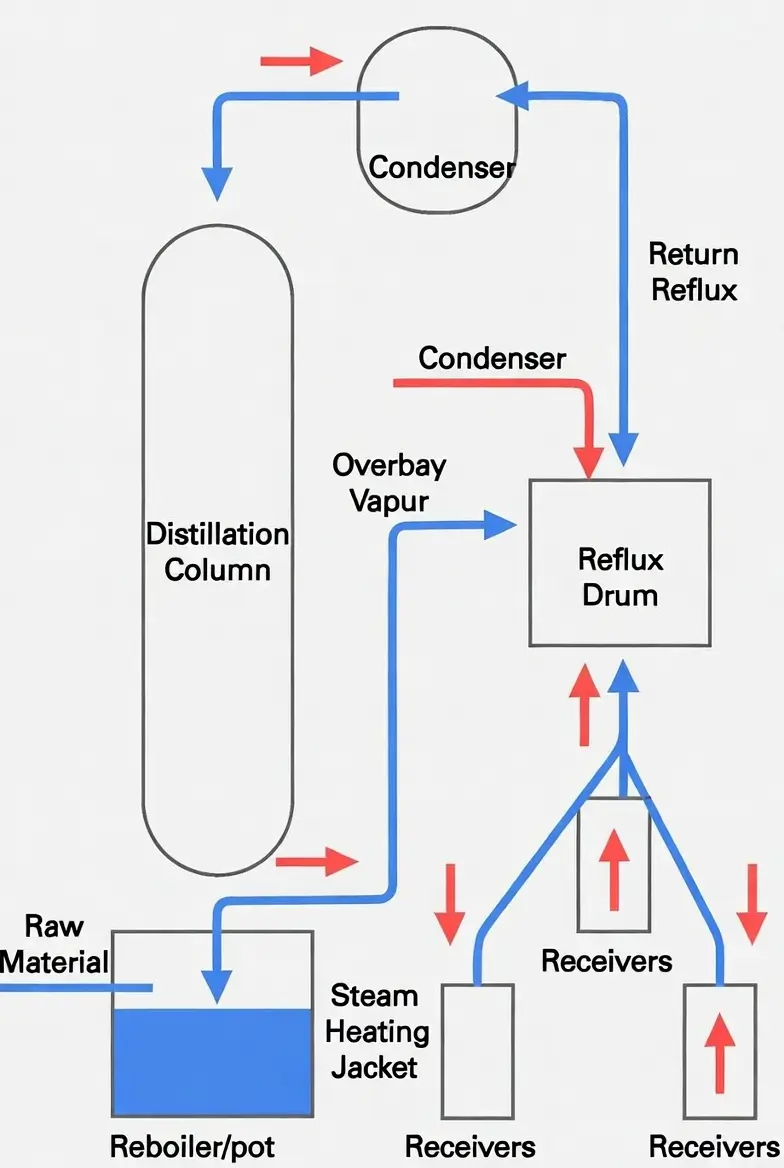
With ongoing discussions around oil supply and naphtha, distillation is once again in focus. However, most attention tends to go to large-scale continuous distillation systems. In this article, we take a closer look at batch distillation—an approach that is often more practical at the plant level.
For mechanical and electrical engineers, batch distillation is closely tied to equipment configuration and overall plant design. Understanding how it works as a system provides valuable insight for both design and operation.
Batch Distillation System Configuration
Distillation can be operated either continuously or in batches. Let’s start by looking at a typical batch distillation system.
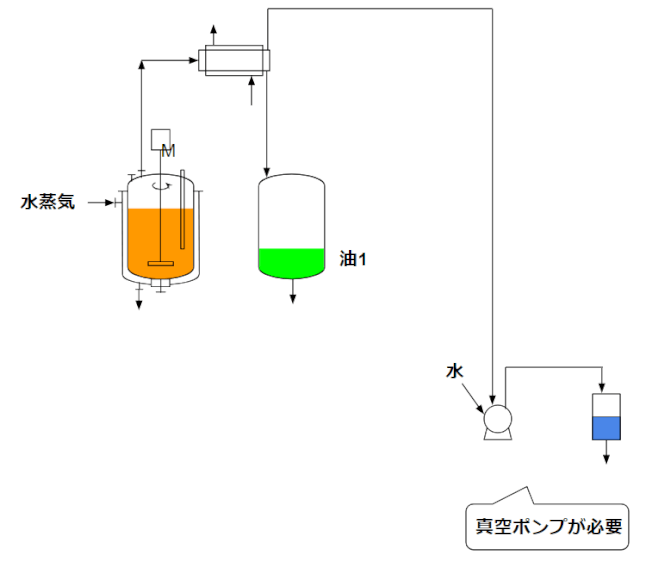
A standard setup consists of:
- Reactor (or vessel)
- Column (optional depending on separation requirement)
- Heat exchanger
- Tanks
- Pumps
- Vacuum pump (if reduced pressure is required)
In addition, the system requires utilities such as:
- Steam
- Cooling water or chilled water
- Nitrogen or air
- Electricity
The key point is that batch distillation is not a single piece of equipment—it is a system built by combining multiple units. This flexibility is one of its defining features.
The column plays a major role in separation performance. In batch systems, structured or random packing is typically selected based on required performance, often with some design margin rather than relying on strict simulation.
A vacuum pump is used when reduced-pressure distillation is required, although atmospheric operation is also possible depending on boiling point and safety considerations. In many cases, including a vacuum system provides greater flexibility.
Compact Footprint
Because batch distillation is based on combining equipment, the required footprint can be relatively small and predictable.
As a rough reference:
- Footprint: ~5 m × 10 m
- Structure height: ~15–20 m
This allows a complete distillation system to be installed within a limited space.
In practice, this means:
- Installing within an existing plant area
- Expanding capacity by adding parallel units
- Repurposing similar equipment
This flexibility makes batch distillation easy to integrate into various plant layouts.
Flexible Production Capability
A compact and modular setup enables flexible production.
Typical use cases include:
- Solvent recovery from in-house waste oil
- Processing waste streams from related plants
- Recovering valuable components from third-party feedstock
Because of its small footprint and similar operating procedures, batch distillation can be deployed in many locations. In fact, there are businesses dedicated solely to distillation services.
When handling multiple feedstocks, however, proper cleaning between batches becomes essential to prevent contamination. This is one of the most significant operational considerations in batch systems.
Performance Depends on Capacity and Material
Capacity
Reactor volume directly determines production capacity.
For example:
- 5 m³ → ~5 tons/day
- 10 m³ → ~10 tons/day
Processing 100 tons of feed:
- 5 m³ system → ~20 days
- 10 m³ system → ~10 days
While larger capacity increases throughput, too low a fill level may prevent stable operation. In practice, production planning often requires adjusting batch size and duration based on total volume.
Material Selection
The main material options are:
- Stainless steel (SUS)
- Glass-lined steel (GL)
GL is suitable for highly corrosive fluids but has lower heat transfer efficiency and is more difficult to repair. SUS is easier to handle but requires attention to corrosion.
In many batch plants, GL equipment is already available, making it common to use or slightly modify existing units for distillation.
Pressure
Batch distillation typically operates under:
- Atmospheric pressure
- Reduced pressure (vacuum)
Vacuum operation depends on pump capability, with around 10 kPa being a practical and commonly achievable range.
Pressure selection affects boiling temperature, safety, and overall operation.
Conclusion
Batch distillation is a flexible process built from a combination of standard equipment. Its relatively small footprint and modular structure make it adaptable to many environments.
Rather than asking whether it can be implemented, the more relevant question is how to configure the system effectively for a given purpose. Understanding this perspective is key to making practical use of batch distillation.
About the Author – NEONEEET
A user‑side chemical plant engineer with 20+ years of end‑to‑end experience across design → production → maintenance → corporate planning. Sharing practical, experience‑based knowledge from real batch‑plant operations. → View full profile



Comments