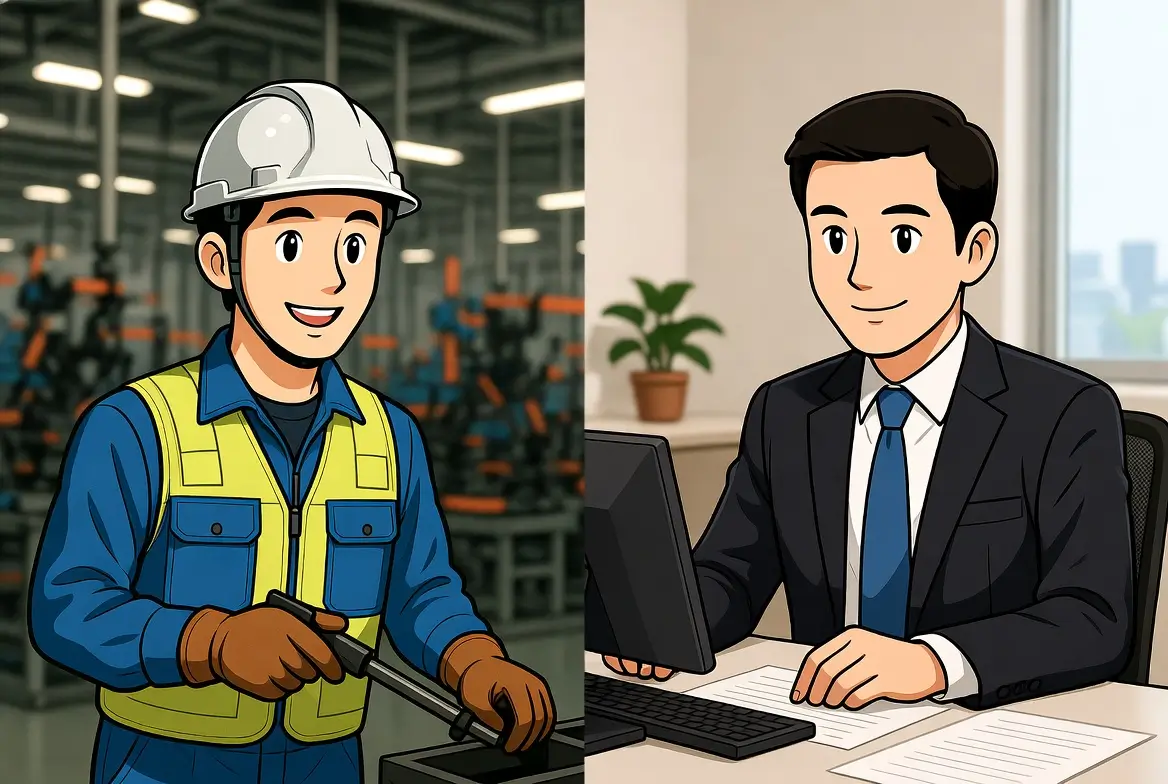
I spent over 20 years working as a mechanical engineer in chemical plant operations, where my focus was primarily on equipment, maintenance, and execution.
Over the past year, however, I transitioned to a corporate planning role at headquarters, where I have had little direct involvement in traditional engineering work. Instead, I have been exposed to the business side of the company.
This shift has significantly changed how I view both plant operations and the role of mechanical engineers.
In this article, I’ll share the key perspective shifts I experienced after stepping away from the plant environment.
How My View of the Plant Changed
A Plant Is Just One Option for Manufacturing
While working in the plant, my mindset was simple: execute the production assigned by headquarters as efficiently and reliably as possible.
I rarely questioned why our plant was selected or what alternatives existed.
However, from a headquarters perspective, a plant is simply one of several options for manufacturing.
If another plant—or even an external partner—can produce the same product more efficiently, it naturally becomes a viable alternative.
This realization changes the perceived position of a plant. It is not inherently “chosen”—it must continuously justify why it should be chosen.
The Hidden Weaknesses of In-House Plants
When you spend your career in a plant, it’s easy to assume:
- “Our quality is high.”
- “Domestic manufacturing is superior.”
- “Lower-cost options must mean lower quality.”
But stepping outside reveals a more nuanced reality.
In many cases:
- Yes, quality is high—but so is cost
- The quality difference may not translate into meaningful product value
- Maintaining high quality often requires excessive operational effort
In other words, high quality alone is not always a competitive advantage if it cannot justify the cost.
This is difficult to fully grasp from within the plant.
Competitors Are Always an Option
In specialized chemical production, it often feels like “only our plant can produce this.”
However, from a business perspective, that assumption rarely holds.
Given sufficient investment, other companies—or other sites—can often replicate the process. The real question is not whether they can produce it, but at what cost.
This shifts the competitive landscape entirely.
The competitiveness of a plant becomes visible through capital investment and operating cost, and survival depends on how efficiently new production can be established.
This is precisely where mechanical engineers can create real value—but ironically, this is the part that is least visible from within the plant.
The Invisible Coordination Behind Plant Operations
Manufacturing Is Supported by Constant Adjustments
In the plant, the instruction is straightforward: produce a defined product at a defined time.
What is not visible is the extensive coordination happening behind the scenes to make that possible.
Process Development Coordination
Processes are typically developed outside the plant, often within R&D teams.
As development progresses toward commercialization, coordination between R&D and the plant becomes necessary, often facilitated by headquarters.
This coordination is not always smooth, and aligning different teams with different priorities becomes a significant task in itself.
Raw Material Coordination
Even when the process is fixed, raw materials are rarely stable.
Multiple supply sources must be secured, and each candidate material must be validated through coordination between suppliers and the plant.
Ensuring reliable material supply is often more challenging than expected, especially for non-standard materials.
Analytical Method Coordination
Adjustments in analytical methods, such as switching columns or refining measurement techniques, also require coordination between R&D and plant teams.
Although less frequent, these changes are critical to maintaining product consistency and quality.
Rethinking the Role of Mechanical Engineers
From Routine Work to Strategic Thinking
In plant operations, work is often structured around recurring tasks such as maintenance and scheduled shutdowns.
It is easy to assume that executing these tasks is the core of the job.
However, from a headquarters perspective, such execution is expected—and the real value lies elsewhere.
The key question becomes:
Can the plant develop and execute a long-term strategy?
Value Is Defined by Cost and Investment
The true value of a mechanical engineer is not just maintaining equipment, but influencing investment decisions and cost structures.
How can we build or modify systems at lower cost?
How can we ensure stable production with minimal capital?
These questions directly impact competitiveness.
Yet, this perspective is difficult to develop when working exclusively within the plant environment.
Final Thoughts
Stepping away from the plant revealed that a plant is not a fixed asset to be protected, but a resource that must continuously prove its value.
It also reshaped my understanding of what it means to be a mechanical engineer—not just someone who manages equipment, but someone who contributes to business competitiveness through cost, investment, and long-term thinking.
For engineers, gaining exposure beyond the plant floor may be one of the most valuable experiences for professional growth.
About the Author – NEONEEET
A user‑side chemical plant engineer with 20+ years of end‑to‑end experience across design → production → maintenance → corporate planning. Sharing practical, experience‑based knowledge from real batch‑plant operations. → View full profile



Comments