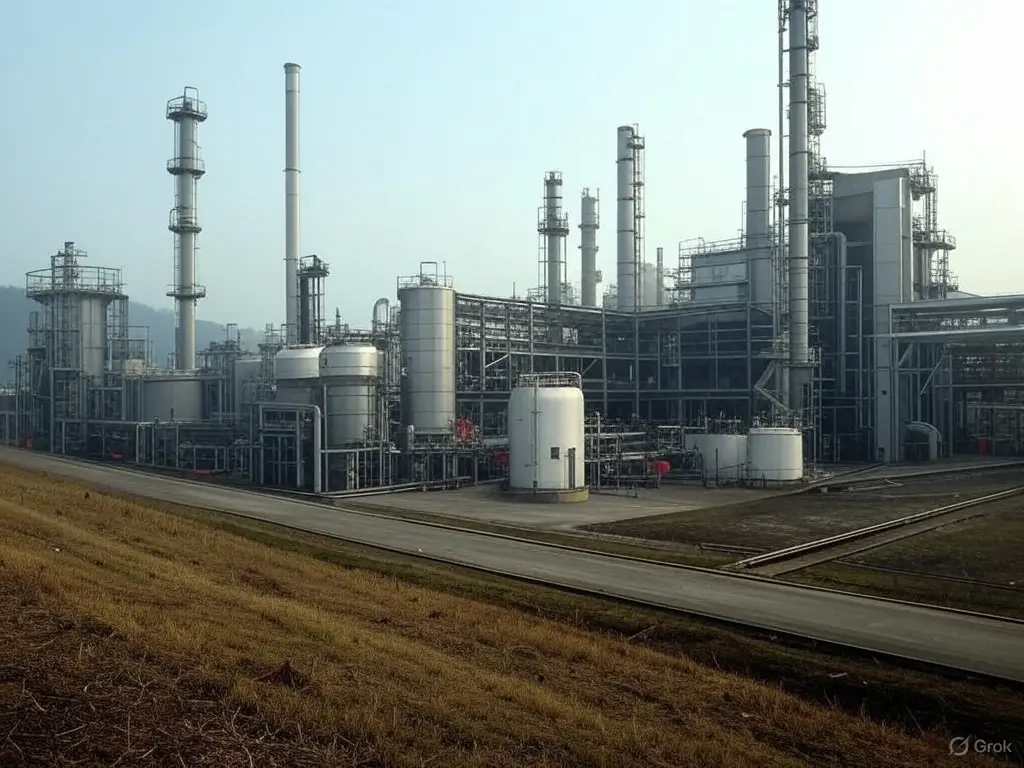
When people imagine a chemical plant, they often picture a forest of tall towers rising above the facility. Distillation columns, absorption towers, and other vertical equipment are iconic elements of chemical processing plants, and many images generated for “chemical plant” scenes inevitably show numerous towers standing side by side.
However, in the type of batch chemical plants I have worked in, the reality is quite different. Tower equipment rarely appears in prominent places, and in some plants it almost seems as if there are no towers at all. More importantly, the opportunities to design towers are surprisingly limited, and even when they do appear, the design process is often far simpler than many engineers expect.
For a long time, I assumed tower design would require complex chemical engineering calculations. But in practice, many towers used in batch plants operate perfectly well with very simple design considerations. In many cases, the most important parameter—and sometimes almost the only one that truly matters—is the column diameter.
What Is Flooding in Packed Towers? Easy Guide for Beginners
Cooling Towers Explained: Principles, Structure, and Circulating Water Management Made Simple
- In Batch Plants, Column Diameter Determines Almost Everything
- Other Specifications Often Follow Practical Experience
- In Some Cases, Even the Diameter Is Determined by the Plant
- Detailed Design Only When It Is Truly Necessary
- The Most Important Requirement: Fitting Inside the Structure
- Conclusion
- About the Author – NEONEEET
In Batch Plants, Column Diameter Determines Almost Everything
In the tower designs I have been involved with in batch chemical plants, the process department usually proposes the basic specifications first. Mechanical engineers then review the design as a secondary check rather than creating the design from scratch.
In many cases, this review focuses primarily on verifying the column diameter.
Column diameter plays a critical role because it directly influences several key aspects of tower operation. It determines the maximum capacity of the equipment by limiting gas velocity through flooding conditions. It also determines whether the equipment can physically fit inside the plant structure. Finally, it strongly affects the cost of the equipment itself.
Because column diameter defines the allowable gas and liquid flow rates, it essentially sets the operating capacity of the tower. In that sense, it is not an exaggeration to say that the performance of the tower is largely determined by this single parameter.
Once the diameter is fixed, the overall scale of the equipment becomes clear, and engineers can evaluate whether it can be installed within the plant layout. If the tower becomes too large, additional structural support or layout modifications may be required.
Other Specifications Often Follow Practical Experience
Although tower design theoretically includes many parameters, in batch plants most of them are determined using practical experience rather than detailed calculations.
Packing type, for example, is usually a standard random packing. The packing height is often determined either by previous plant experience or simply by the maximum height that fits within the available structure. Material selection typically focuses on corrosion resistance, commonly using materials such as stainless steel (SUS316L) or glass-lined steel.
In reality, many towers in batch plants are relatively simple pieces of equipment. As long as the tower is filled with packing and provides sufficient gas–liquid contact area, it often performs adequately for the required process conditions. Detailed performance calculations may not significantly change the design because the selected equipment size often already contains a large safety margin.
Sometimes engineers intentionally choose a tower slightly larger than necessary. This approach allows the equipment to handle future products or process changes, which improves plant flexibility.
As a result, specifications tend to become standardized, and eventually the column diameter remains the only parameter that truly requires calculation.
In Some Cases, Even the Diameter Is Determined by the Plant
Interestingly, in certain situations the column diameter itself may be indirectly determined by other plant equipment.
For example, gas generation rates may be limited by the reactor size or by the diameter of the gas piping system. If those upstream constraints already define the maximum gas flow rate, the tower only needs to be large enough to handle that amount of gas. In such cases, the tower diameter naturally follows the constraints imposed by the rest of the plant.
Detailed Design Only When It Is Truly Necessary
In many batch chemical plants, tower design relies heavily on existing experience and standardized equipment. As a result, engineers sometimes create new towers simply by copying previously successful designs.
This may sound surprising from a strict chemical engineering perspective, but in practice it works because the required separation or absorption performance in batch operations is often not extremely demanding.
If higher performance becomes necessary, detailed simulations can always be performed using specialized process simulation software. At that stage, engineers can conduct more rigorous analysis or consult specialists. Until then, however, simple designs often function perfectly well.
From a practical engineering perspective, it is not always necessary to master every aspect of tower design in advance. In many roles, engineers gain more benefit by focusing on a broader set of plant design and operation skills.
Of course, the situation is different in continuous plants where towers are the central equipment. In such facilities, tower design expertise becomes a core engineering skill.
The Most Important Requirement: Fitting Inside the Structure
One important difference between batch plants and large continuous plants is how towers are installed.
In many continuous plants, towers stand independently from the main structures and extend high above the facility. The surrounding structures mainly provide access platforms and stairways.
Batch plants are often designed very differently. Towers are usually required to fit inside the plant structure itself, mainly for cost reasons. Structural steel frames support multiple pieces of equipment within a compact space, and towers must be designed to fit within those constraints.
Because of this arrangement, towers in batch plants are often hidden within the structural framework of the building. From the outside, the plant may appear to have no towers at all—even though several are actually integrated inside the structure.
Conclusion
Tower design in batch chemical plants is often far simpler than many engineers expect. While chemical engineering theory provides detailed methods for designing columns, the practical requirements in batch operations are usually modest. As a result, many designs rely heavily on practical experience and standardized equipment.
In these situations, the column diameter becomes the most critical design parameter because it determines both operating capacity and equipment scale. Once the diameter is established, many other specifications can be chosen based on plant experience, structural constraints, and corrosion resistance requirements.
Understanding this practical reality helps engineers focus their efforts where it matters most—balancing process requirements, plant layout, and equipment flexibility.
About the Author – NEONEEET
A user‑side chemical plant engineer with 20+ years of end‑to‑end experience across design → production → maintenance → corporate planning. Sharing practical, experience‑based knowledge from real batch‑plant operations. → View full profile



Comments