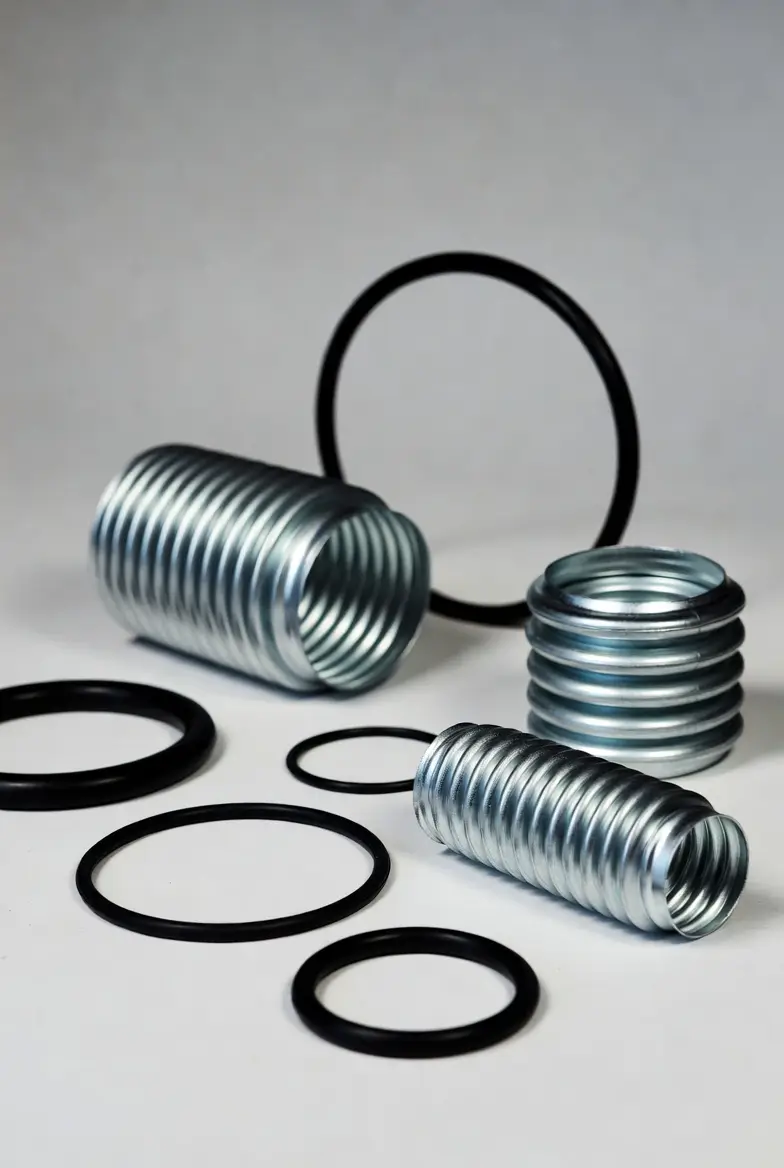
In chemical plants, preventing leaks is always the top priority. This becomes even more critical when equipment handles gases, hazardous chemicals, or toxic substances. In such environments, sealing performance directly affects safety, operational stability, and maintenance costs.
Two sealing approaches that are often compared in practice are O-rings and bellows.
Both are widely used in chemical plant equipment, and in many situations either solution may technically work. However, understanding which one provides better leak resistance and under what conditions is an important step for engineers involved in equipment design or maintenance.
This article explains the practical differences between O-rings and bellows from a chemical plant engineering perspective, focusing on how their sealing performance differs and how they should be selected.
Why Mechanical Seals Leak in Pumps — and How to Fix It
What Is a Gland Packing (Gland Seal)? A Clear Guide to Its Purpose, Mechanism, and Use Cases
Top 3 Mechanical Seal Flushing Plans Explained (API 682 Standards)
Essential Guide to Mechanical Seal Support Systems in Chemical Plants
When in Doubt, Choose a Double Mechanical Seal: Practical Reasons for Chemical Plants
What Is a Labyrinth Seal in Chemical Plants?
Seal Basics for Chemical Plants: How to Prevent Leakage Through Proper Design and Selection
Why Do Large-Diameter Seals Leak?
O-Rings Provide Stronger Sealing
When comparing sealing capability alone, O-rings generally provide stronger sealing performance than bellows.
The reason lies in how these components behave mechanically. In static sealing applications, once an O-ring is installed it normally does not move at all. Even in dynamic applications, the movement is usually very small and only occurs because the rotating shaft slightly drags the O-ring.
If the O-ring were to rotate at the same speed as the shaft, it would no longer function as an effective seal. In normal designs, however, the movement remains minimal and the compression of the elastomer maintains tight sealing contact.
Bellows, on the other hand, are designed to expand and contract. Because they must allow a certain amount of axial movement, they inherently require flexibility. According to basic mechanical principles, components designed for larger deformation generally have lower structural strength than rigid sealing elements.
For this reason, when pressure resistance and sealing strength are the main priorities, O-ring designs are usually the safer choice.
In chemical plant equipment such as reactor shaft seals, catalogs often offer both O-ring and bellows configurations. When reviewing such designs, it is useful to keep this strength difference in mind.
O-Rings Allow More Compact Designs
Another advantage of O-rings is that they allow more compact equipment designs.
Because bellows must physically expand and contract to accommodate movement, they require additional space in the axial direction. O-rings, by contrast, achieve sealing through elastic compression and therefore require far less structural space.
In practice, however, plant engineers rarely encounter situations where equipment size is dramatically reduced simply because an O-ring was chosen. While compactness is technically an advantage, it is usually not the primary decision factor in chemical plant applications.
Bellows Are Well Suited for Internal Moving Parts
Bellows are commonly used for internal components in chemical plant equipment, especially where movement is required.
Many internal mechanisms in process equipment must move while still maintaining isolation from process fluids. Attempting to design such mechanisms using O-rings alone often results in complicated or unreliable structures.
Bellows provide a simpler solution because they naturally accommodate axial motion while maintaining sealing separation.
This is particularly important in equipment such as powder handling systems, where internal components must move while preventing process materials from escaping or contaminating other areas.
In general, O-rings should not be used for components that require significant motion. For moving internal parts, bellows are typically the better engineering solution.
Bellows Are More Resistant to Foreign Particle Issues
Another practical advantage of bellows is that they are less sensitive to particle contamination.
Dynamic O-ring seals may suffer from wear if foreign particles become trapped between the sealing surfaces. Over time, this wear can degrade sealing performance and generate additional debris.
Bellows do not rely on sliding contact in the same way, which reduces the risk of wear caused by particles. For this reason, powder processing equipment often favors bellows designs to minimize contamination risks.
Bellows Can Be More Cost-Effective
In chemical plant environments, bellows can sometimes be more economical.
O-rings used in aggressive chemical services often require high-performance materials such as perfluoroelastomers (FFKM), which are significantly more expensive than standard elastomers.
Bellows designs, however, are often less sensitive to the specific fluoropolymer grade used, and in some cases the overall cost may be lower than an equivalent O-ring solution made from premium materials.
Standard fluorocarbon O-rings can still be inexpensive, but in chemical plants they are not always chemically compatible, which limits their use.
Be Careful When Using Bellows in Rotating Applications
When bellows are used in rotating shaft seals, additional caution is required.
Bellows are primarily designed to absorb axial movement. If they are also required to accommodate rotational forces, the mechanical stresses become more complex.
As a general engineering principle, components designed to perform a single function tend to have longer service life, whereas components forced to perform multiple functions often experience reduced durability.
Although bellows can appear convenient, they do have limitations that must be considered carefully during design.
Conclusion
The question of whether O-rings or bellows provide better leak resistance does not have a single universal answer.
Under stable and static conditions, O-rings often provide extremely reliable sealing performance. However, in equipment involving shaft motion or internal mechanical movement, bellows may be essential to maintain isolation and reliability.
Therefore, the key design decision is not simply which seal is “better,” but rather which type of leak risk must be minimized and which design priority matters most.
Understanding this balance is an important step for engineers working in chemical plant design, operation, and maintenance.
About the Author – NEONEEET
A user‑side chemical plant engineer with 20+ years of end‑to‑end experience across design → production → maintenance → corporate planning. Sharing practical, experience‑based knowledge from real batch‑plant operations. → View full profile



Comments