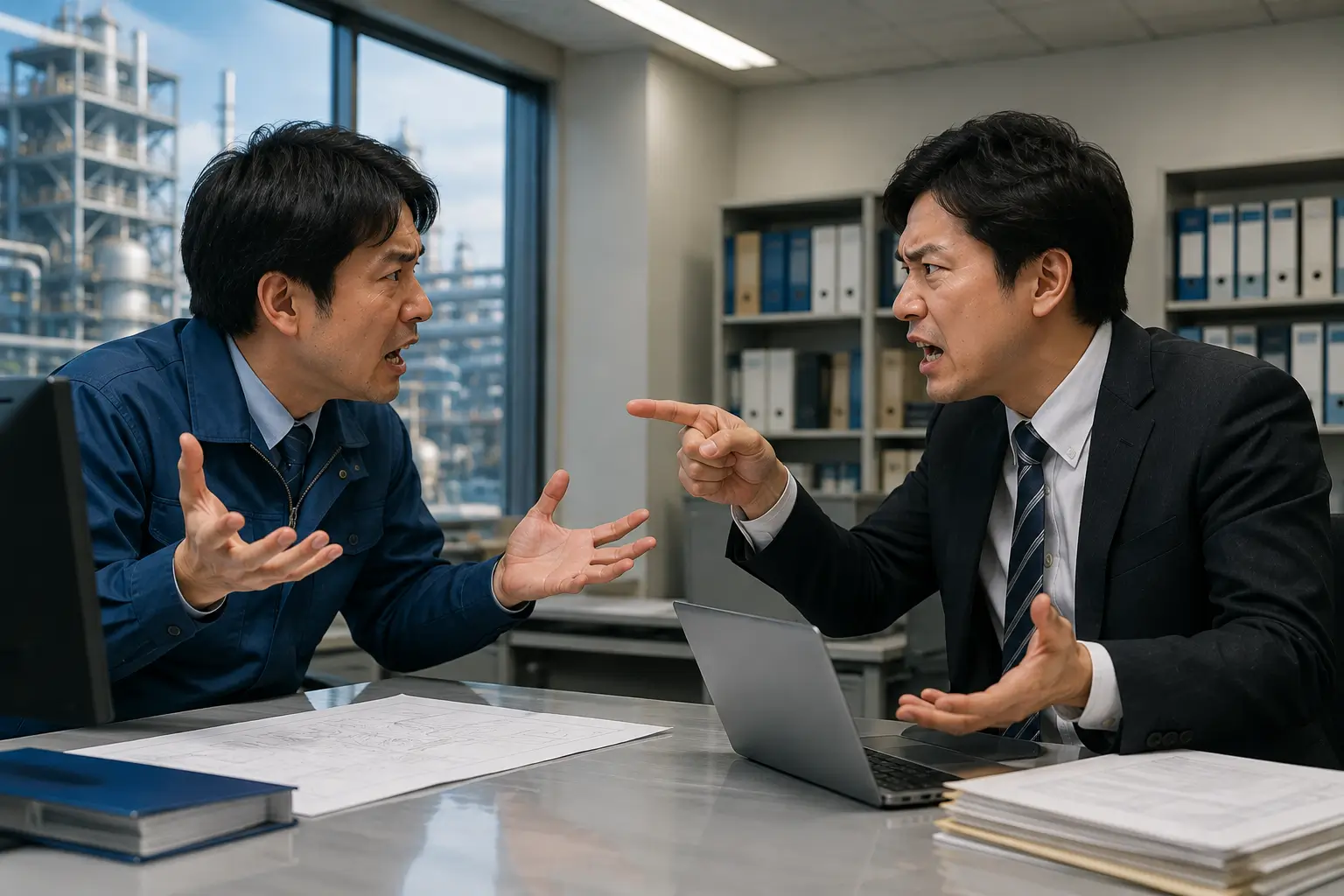
In manufacturing companies, engineering and procurement often have different priorities.
Engineering wants to make sure that the required equipment and materials are available when the plant needs them. Procurement, on the other hand, has to manage suppliers, prices, lead times, purchasing procedures, and many other constraints.
As a result, I sometimes see discussions where engineering criticizes procurement, or procurement argues that problems at the plant should be solved by the plant itself.
But both departments work for the same company.
Ideally, they should be working toward the same objective rather than optimizing their own departments separately.
I have worked in production engineering for about 15 years, and my view of procurement has changed considerably during that time.
Based on my experience, I believe that procurement was the bigger problem in the situation that triggered this discussion, although I do not mean that procurement alone was responsible.
The actual situation varies depending on the company, plant, equipment, and procurement organization, so the following should not be regarded as a universal rule.
Instead, I would like to share some practical approaches that can help reduce problems between production engineering and procurement.
What Production Engineering Can Do
Even when procurement appears to be the main problem, production engineering also has many things it can do.
The following approaches are based on my own experience. I did not necessarily use all of them from the beginning. Many of these practices were developed gradually through trial and error whenever problems occurred.
Submit Purchase Requests Early
The first thing production engineering can do is submit purchase requests as early as possible.
When supply-chain disruptions caused lead-time problems in the past, one of the instructions from management was to submit procurement requests earlier.
However, there is an important message behind such an instruction.
If process engineering or manufacturing does not finalize the required specifications in time, equipment may not be available when production needs it, potentially resulting in a production shutdown.
Therefore, production engineering should not simply wait for upstream departments to finalize everything.
Sometimes, engineering needs to push upstream and say:
If we cannot finalize the requirements now, we may not be able to obtain the equipment in time.
This can be difficult because production engineering may hesitate to challenge manufacturing or process engineering.
However, suppliers cannot deliver equipment that has not been properly specified and ordered.
In the case that triggered this discussion, the lead time was approximately two weeks, while the purchase order was placed about one and a half months in advance.
From a production engineering perspective, that was actually a fairly proactive approach.
If information about supplier delays was already available, I would not consider this a major failure on the engineering side.
In fact, I have seen engineers delay purchasing even when their organization had already instructed them to place orders early.
Therefore, I think the person involved was probably being cautious even without having a strong organizational consensus behind them.
Build Buffer Time into the Required Delivery Date
The next step is to build some buffer into the required delivery date.
This may not have been realistic in the particular case that triggered the discussion because the overall period was already quite short.
However, in batch chemical plants, we often deal with long-lead-time equipment that can take one to one and a half years to procure.
In such cases, ordering early is important, but it can also be useful to specify a required delivery date with some additional buffer.
If equipment arrives at the plant one month earlier than absolutely necessary, it may only create a temporary storage issue. It does not necessarily affect the construction schedule.
Of course, this approach should not become excessive.
If every project is given a large buffer, procurement and suppliers may eventually start thinking that a particular engineer’s projects always have plenty of time.
Fortunately, I did not experience this becoming a serious problem.
Tell Procurement When a Project Is Critical
If a delay could actually shut down the plant and the deadline is approaching, I believe the project should be explicitly communicated to procurement as a critical or special case.
At my previous workplace, we used SAP Ariba, which allowed comments to be recorded between the requesting and purchasing sides.
However, simply leaving a comment in a procurement system is not always sufficient.
Someone may not notice it.
Therefore, for particularly important projects, I would also follow up by email, phone, or face-to-face communication.
The important point is to make sure that procurement understands the urgency.
In my experience, I only had a few projects per year that genuinely required this kind of special treatment, and procurement generally cooperated well.
However, if a department has so many urgent requests that procurement can no longer treat any of them as special, that is no longer an individual problem.
It becomes an organizational problem.
Regularly Check Procurement Progress
If the supplier is known to have uncertain lead times or slow responses, production engineering should periodically check the procurement status, particularly when a delay could affect plant operation.
For example, in a situation similar to the one discussed here, asking once a week,
“How is the quotation progressing?”
might have been reasonable.
Of course, that is easy to say after the fact.
Production engineers tend to be very concerned about procurement before submitting a request. Once the request has been handed over to procurement, however, they often stop actively monitoring it.
There is an implicit assumption that procurement will manage everything from that point onward.
For example:
Procurement should make sure the supplier meets the requested delivery date.
If the quotation is delayed, procurement should inform engineering.
That approach is understandable.
However, once you realize that simply trusting the process does not always work, it can be worthwhile for production engineering to keep monitoring critical orders.
It may be inconvenient, but dealing with the consequences after a missed deadline is usually much more difficult.
Consider Early Procurement
If procurement procedures themselves are causing delays, early procurement can sometimes be considered.
However, I regard this as a last resort.
One reason is that early procurement can reduce the ability to negotiate price and commercial conditions.
Ideally, production engineering should manage the schedule well enough that such emergency procurement is unnecessary.
In other words, the objective is not simply to find a way to place an order early, but to prevent the project from reaching a situation where early procurement becomes necessary.
Consider Alternative Equipment or Suppliers
Production engineering does not have many direct tools for solving procurement problems, but one option is to consider alternative equipment or suppliers.
For example, instead of insisting on a specific manufacturer’s ball valve, another manufacturer’s equivalent product might be considered.
Of course, finding an alternative that satisfies cost, performance, specifications, and plant requirements is not always easy.
There can also be significant resistance from the manufacturing side.
Another possibility is to check whether similar equipment is already being procured for another plant.
This requires communication with procurement and negotiation with the engineer responsible for the other plant.
I have successfully used this approach only a few times during my 15 years in production engineering because timing is critical.
This is also why supplier diversification is important.
If a plant always relies on a single preferred supplier simply because that supplier has a good track record, the organization can become extremely vulnerable when that supplier suddenly has a capacity or delivery problem.
Chemical plant valves are a good example.
Consider Reusing Equipment from Another Plant
Sometimes equipment that is difficult to procure may already exist in another plant.
If the other plant is shut down or does not currently need the equipment, temporary or permanent reassignment may be possible.
Batch plants can sometimes make this easier because production does not always require every piece of equipment at all times.
Some products may not require a particular piece of equipment, which can create opportunities to share resources between plants.
However, this requires broad communication and, more importantly, trust between people and departments.
Without that relationship, even technically simple solutions can become difficult to implement.
Review the Production Plan
If the equipment cannot be procured and no existing equipment can be reused, the next step may be to review the production plan.
Batch plants have a certain degree of flexibility because products can sometimes be rescheduled or production sequences can be changed.
Changing the production plan may initially look like a failure for both engineering and manufacturing.
However, depending on the company, it may actually be evaluated as a successful attempt to minimize the overall impact of the problem.
The important point is to distinguish between departmental performance and overall business impact.
What Procurement Can Do
Even though production engineering has many things it can do, I still believe procurement has an important responsibility in this type of situation.
A major issue is communication.
There are also several things procurement can do to help engineering identify risks earlier.
Share Trends in Lead Times and Prices
Procurement generally has better visibility into supplier lead times and price trends than production engineering.
Therefore, procurement should regularly share this information with engineering.
The information may already have been available in the particular case discussed here, but from the outside it can look as though engineering had to identify the risk on its own.
Engineering and procurement can also have very different perceptions of the same supplier.
A supplier may respond quickly to procurement because procurement controls the commercial relationship, while responding slowly to engineering because engineering is asking technical questions.
This can create an interesting difference in perception.
Procurement may think:
“This supplier is reliable.”
Engineering may think:
“This supplier is difficult to work with.”
Both perceptions can be correct.
Therefore, procurement should share information about supplier performance, lead times, pricing, and market conditions in a way that production engineering can actually use.
At one point in my experience, there were situations where procurement effectively took the position that:
“Problems at the plant should be solved by the plant. Procurement is not responsible.”
When delivery delays or budget overruns occurred, the responsibility was pushed back to the plant.
I believe this kind of organizational boundary is ultimately harmful to the company.
Share Quotation Deadlines and Procurement Progress
Another problem is that production engineering often cannot see what happens between submitting a purchase request and receiving supplier quotations.
For example, a company may normally expect quotations within two weeks.
But what happens if a supplier takes one month?
And what happens if procurement has to wait for quotations from several suppliers before evaluating them?
If engineering cannot see these intermediate steps, it may assume that everything is progressing normally.
Sharing quotation deadlines and procurement milestones with engineering would allow engineers to pay more attention to critical projects.
Even if the procurement system records the deadline, that does not necessarily mean someone is actively monitoring it.
For critical projects, an old-fashioned approach can sometimes be surprisingly effective:
Ask procurement directly.
It may not be the most sophisticated system, but direct communication is often more reliable than assuming that everyone is looking at the same information.
Share Information from Similar Projects
Procurement often has information that production engineering does not.
For example, procurement may know that another project is currently purchasing similar equipment, or that a similar item was purchased successfully from another supplier in the past.
That information can be extremely valuable when a current order is facing a delivery problem.
If a plant may stop because equipment will not arrive on time, expecting production engineering alone to solve the problem is not reasonable.
Procurement should also share possible options, such as alternative suppliers, partial deliveries, revised delivery schedules, or similar equipment already available within the company.
What Can Be Done After a Delivery Delay Is Identified?
Once a serious delivery delay has already become clear, the number of realistic options becomes much smaller.
Procurement may ask the supplier to accelerate production, but relying entirely on the supplier to solve the problem is not always realistic.
If a company repeatedly makes unreasonable demands, suppliers may eventually become reluctant to work with it.
Therefore, the response may ultimately have to be unpleasant.
For a repair project, the plant may have to continue operating with the existing equipment while accepting a certain level of risk.
For a new project, the production schedule may have to be changed.
Of course, operating a chemical plant while knowingly accepting additional risk is a serious matter.
In a hazardous industrial environment, “we will take the risk and keep operating” is not a simple decision.
Furthermore, production engineering may have to spend additional time supporting the plant until the situation returns to normal.
That additional engineering workload is often invisible to procurement.
This is one reason why the impact of procurement problems should not be evaluated only by looking at the purchase order itself.
Conclusion
The relationship between production engineering and procurement is a common challenge in manufacturing.
Neither side is necessarily the “bad side.”
Production engineering has a responsibility to plan ahead, communicate risks, consider alternatives, and monitor critical projects.
At the same time, procurement has access to supplier information, lead-time trends, pricing information, quotation status, and alternative sourcing options that engineering often cannot see.
The real problem begins when each department focuses only on its own responsibilities.
Production engineering says:
“Procurement should have managed the supplier.”
Procurement says:
“The plant should have ordered earlier.”
Manufacturing says:
“We cannot produce because the equipment is not available.”
Each statement may be reasonable from an individual department’s perspective.
But the company as a whole still has the same problem.
The goal should not be departmental optimization. It should be minimizing the total impact on the plant and the business.
That requires more than procedures and procurement systems.
It requires a culture where engineering, procurement, manufacturing, and planning can openly discuss problems before they become emergencies.
After all, they are all working for the same company.
About the Author – NEONEEET
A user‑side chemical plant engineer with 20+ years of end‑to‑end experience across design → production → maintenance → corporate planning. Sharing practical, experience‑based knowledge from real batch‑plant operations. → View full profile



Comments