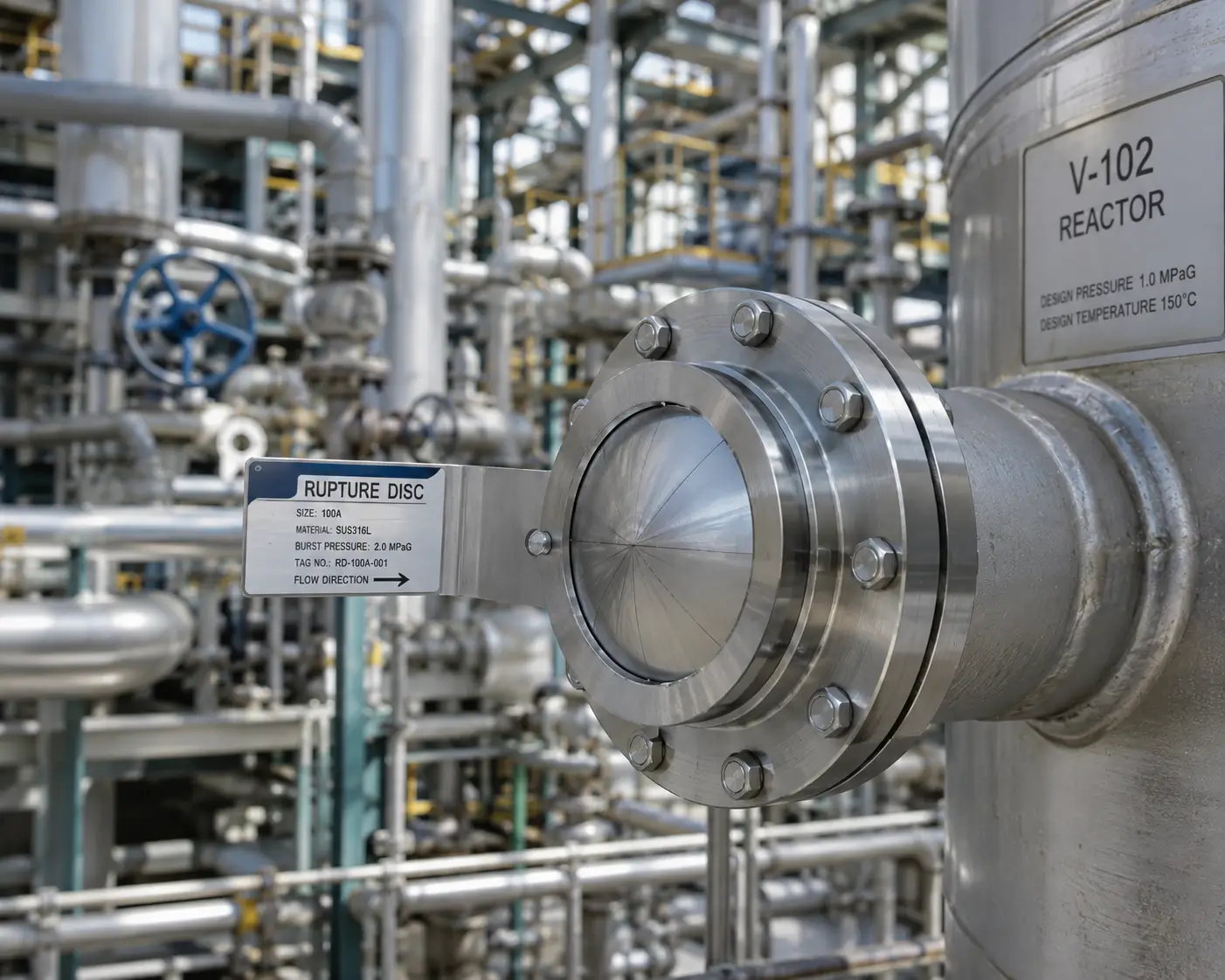
Pressure vessels in chemical plants require reliable overpressure protection. While pressure safety valves (PSVs) are the most common solution, rupture disks (bursting discs) are often preferred in batch processing plants, corrosion-resistant systems, and applications requiring minimal maintenance.
A rupture disk is a thin metallic membrane designed to burst at a predetermined pressure. Once the pressure inside a vessel exceeds its design limit, the disk ruptures instantly, releasing pressure before catastrophic vessel failure can occur.
Unlike a PSV, a rupture disk contains no moving parts, making it one of the simplest and most reliable passive safety devices used in process industries.
This article explains how rupture disks work, their advantages, material selection, installation methods, and when they are preferred over safety relief valves.
The Role of a Rupture Disk
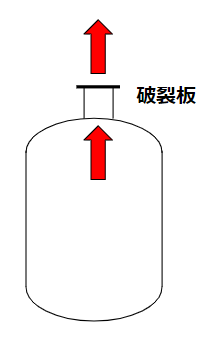
The primary purpose of a rupture disk is to protect pressure vessels from excessive internal pressure.
When an abnormal reaction, thermal expansion, or process upset causes pressure to rise rapidly, the rupture disk bursts and immediately vents the pressure to a designated safe location.
Without such protection, the vessel itself could fail, potentially releasing hazardous chemicals and creating serious safety risks.
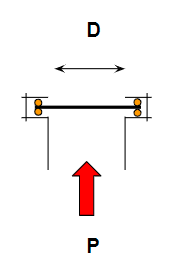
Mechanically, a rupture disk is simply clamped between two flanges.
Its burst pressure is determined by factors such as:
- Material strength
- Disk thickness
- Diameter
- Geometry
Because burst pressure depends heavily on thickness, rupture disks are often manufactured from extremely thin metal sheets. In some applications, the effective thickness may be less than 1 mm, or the disk may include precision-machined grooves to ensure predictable bursting behavior.
Advantages of Rupture Disks
1. Excellent Corrosion Resistance
One of the biggest advantages of rupture disks is material flexibility.
They can be manufactured from:
- Stainless steel
- Nickel alloys
- Carbon steel
- Exotic corrosion-resistant materials
In glass-lined reactors and highly corrosive chemical services, rupture disks are often much more economical than manufacturing an entire PSV from expensive corrosion-resistant alloys.
2. Fast Pressure Release
A rupture disk provides an almost unrestricted discharge path once it bursts.
Since it can be mounted directly on the vessel nozzle with minimal outlet piping, pressure is released immediately with very little pressure loss.
A PSV, in contrast, generally requires additional piping and fittings that introduce flow resistance and increase back pressure.
For rapid pressure relief, rupture disks offer a significant advantage.
3. Minimal Maintenance
Unlike PSVs, rupture disks require virtually no routine maintenance.
Pressure relief valves must be periodically tested, calibrated, and inspected to verify opening pressure.
A rupture disk remains installed until it operates—or until it is replaced during scheduled maintenance.
Many rupture disks remain in service throughout the entire operating life of the equipment without ever activating.
For maintenance engineers managing hundreds or thousands of assets, reducing inspection requirements can significantly lower lifecycle costs.
Typical Installation Configurations
Standalone Rupture Disk
The simplest arrangement is installing the rupture disk directly on top of a pressure vessel.
This configuration is commonly used on:
- Glass-lined reactors
- Batch reactors
- Outdoor chemical storage tanks
- Corrosion-sensitive equipment
The discharge is typically directed upward to minimize hazards to nearby personnel and equipment.
Parallel Installation with a PSV
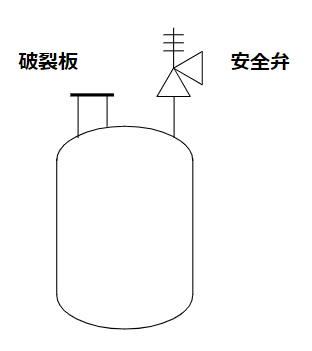
In high-risk applications, a rupture disk and PSV may both protect the same vessel.
This provides redundant overpressure protection and improves overall system reliability.
Although common in some continuous processing industries, this arrangement is less common in batch chemical plants.
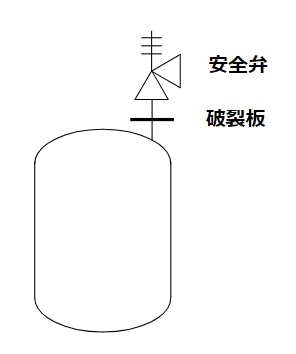
Series Installation with a PSV
A rupture disk may also be installed upstream of a PSV.
This configuration isolates the PSV from corrosive process fluids while preserving its pressure-relief function.
A pressure indicator is often installed between the rupture disk and the PSV to detect premature disk failure.
Although theoretically possible, rupture disk failure without PSV activation is relatively uncommon in practice.
Design Considerations
When selecting a rupture disk, engineers should evaluate:
- Required burst pressure
- Process temperature
- Corrosion resistance
- Pressure cycling
- Discharge direction
- Applicable pressure vessel codes
- Inspection and replacement strategy
Proper installation is just as important as proper sizing.
Incorrect torque, flange alignment, or gasket selection can alter the actual burst pressure and compromise protection.
Conclusion
Rupture disks provide a simple, reliable, and maintenance-friendly method of protecting pressure vessels from overpressure.
Compared with pressure safety valves, they offer several important advantages:
- Simple construction with no moving parts
- Excellent corrosion resistance
- Immediate pressure release
- Very low maintenance requirements
For batch chemical plants, glass-lined reactors, and corrosive process services, rupture disks are often the preferred engineering solution.
Understanding when to choose a rupture disk instead of a PSV helps engineers design safer, more reliable, and more cost-effective process facilities.
About the Author – NEONEEET
A user‑side chemical plant engineer with 20+ years of end‑to‑end experience across design → production → maintenance → corporate planning. Sharing practical, experience‑based knowledge from real batch‑plant operations. → View full profile



Comments