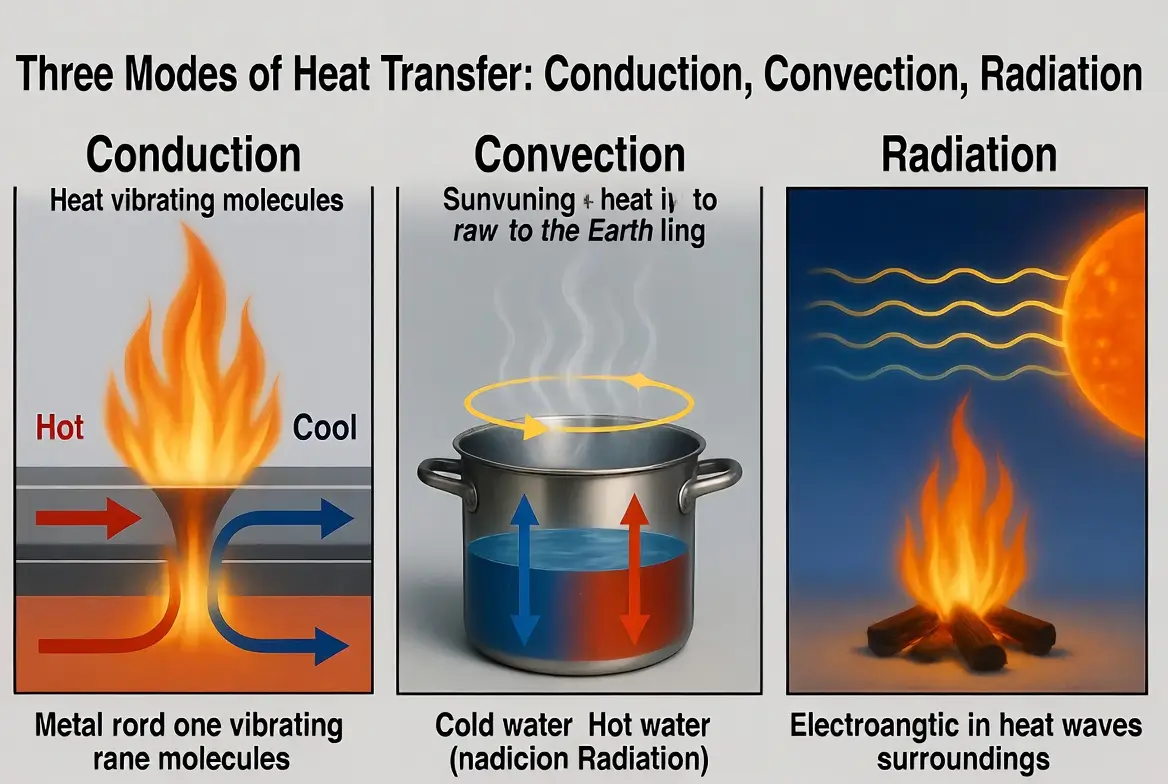
Understanding how heat moves through equipment is one of the foundations of chemical plant engineering. Whether you are designing a heat exchanger, sizing a reactor jacket, troubleshooting poor cooling performance, or optimizing utility consumption, heat transfer is involved.
Many mechanical engineers initially find heat transfer theory intimidating because it introduces dimensionless numbers, empirical correlations, and numerous equations. In reality, however, practical engineering requires understanding only the physical concepts behind the equations rather than memorizing every formula.
This article explains the three fundamental heat transfer mechanisms—conduction, convection, and radiation—from the perspective of practical plant engineering.
- The Three Modes of Heat Transfer
- Conduction
- Convection
- Radiation
- Comparing the Three Heat Transfer Modes
- Overall Heat Transfer Coefficient
- Why Surface Temperature Matters
- Wind and Convective Heat Transfer
- Heat Transfer Units
- Practical Engineering Is More Important Than Memorizing Equations
- Conclusion
- About the Author – NEONEEET
The Three Modes of Heat Transfer
Heat is transferred through three basic mechanisms:
- Conduction
- Convection
- Radiation
Every heat transfer problem in a chemical plant consists of one or a combination of these mechanisms.
Conduction
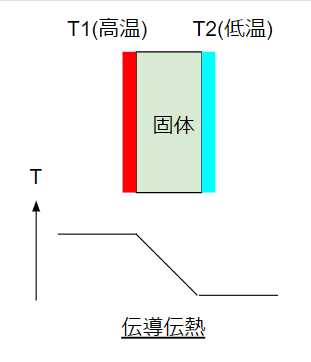
Conduction is the transfer of heat through a solid material without any bulk movement.
A simple example is heat passing through the wall of a pipe or a heat exchanger tube.
The governing principle is Fourier’s Law.
Heat transfer increases when:
- Thermal conductivity is higher.
- Wall thickness is smaller.
- Temperature difference is larger.
Metals such as copper and aluminum have excellent thermal conductivity, while materials like plastics and glass act as thermal insulators.
In chemical plants, wall thickness usually cannot be adjusted freely because pressure vessel design determines the minimum thickness. Likewise, operating temperatures are often fixed by process requirements.
As a result, engineers rarely optimize heat transfer by changing wall thickness or process temperature. Instead, they improve performance mainly by enhancing convection.
Convection
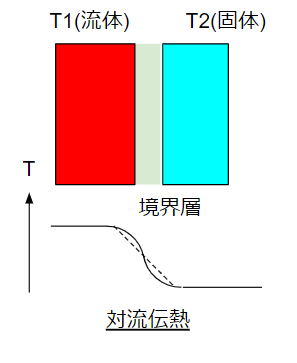
Convection occurs when heat is transported by a moving fluid.
Unlike conduction, convection depends not only on material properties but also on fluid velocity, viscosity, density, and flow conditions.
This is why convection is significantly more complicated than conduction.
Engineers commonly describe convection using dimensionless numbers such as:
- Nusselt Number (Nu)
- Reynolds Number (Re)
- Prandtl Number (Pr)
- Grashof Number (Gr)
Although these numbers may appear mathematical, they simply describe how efficiently heat moves between a solid surface and a flowing fluid.
Forced convection, produced by pumps or fans, mainly depends on Reynolds Number.
Natural convection, driven by buoyancy, depends primarily on Grashof Number.
In chemical plants, forced convection dominates because pumps continuously circulate process fluids.
Radiation
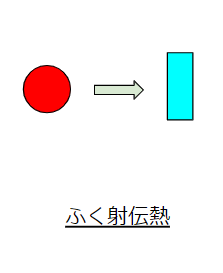
Radiation transfers heat through electromagnetic waves and does not require any physical medium.
The most familiar example is sunlight.
Unlike conduction or convection, radiation can occur through a vacuum.
For most batch chemical processes operating below a few hundred degrees Celsius, radiation contributes only a small portion of total heat transfer.
However, high-temperature equipment such as boilers, furnaces, and fired heaters relies heavily on radiation.
At temperatures approaching 1000°C, radiative heat transfer becomes comparable to convective heat transfer and cannot be ignored.
Comparing the Three Heat Transfer Modes
In practical chemical plants:
Conduction through steel walls is generally moderate.
Convection usually dominates because liquids, steam condensation, and boiling produce very high heat transfer coefficients.
Radiation becomes significant only in high-temperature equipment.
Understanding which mechanism controls heat transfer allows engineers to focus their design efforts where improvements actually matter.
Overall Heat Transfer Coefficient
One of the most important concepts in heat exchanger design is the overall heat transfer coefficient (U-value).
Rather than treating conduction and convection separately, engineers combine all thermal resistances into a single value.
This makes heat exchanger calculations much simpler while still representing the actual physical behavior.
An experienced engineer does not simply calculate U.
They also imagine the temperature profile through the fluid, tube wall, and opposite fluid.
Visualizing surface temperatures helps predict:
- Fouling
- Thermal stress
- Lining damage
- Material selection
This practical intuition is often more valuable than solving equations alone.
Why Surface Temperature Matters
Different combinations of fluids produce different temperature distributions.
For example:
- Liquid-to-liquid heat exchangers usually have relatively balanced temperature gradients.
- Air-to-liquid systems exhibit much larger thermal resistance on the air side.
- Boiling or condensation dramatically increases heat transfer, creating steep temperature gradients inside the tube wall.
Understanding these patterns helps engineers diagnose operational problems and prevent equipment failures.
Wind and Convective Heat Transfer
A familiar example of convection is wind chill.
When wind speed increases, the boundary layer surrounding a surface becomes thinner.
As thermal resistance decreases, heat escapes more rapidly.
This is why a windy day feels colder than a calm day at the same air temperature.
The same principle explains why increasing fluid velocity inside a heat exchanger often improves thermal performance.
Heat Transfer Units
Older chemical plants often express heat duty in kcal/h, while modern engineering standards use kW.
Useful conversions include:
- 1 kcal = 4.186 kJ
- 1 kW ≈ 860 kcal/h
Although SI units are now standard worldwide, many experienced engineers still think naturally in kcal/h because cooling water calculations become intuitive.
Understanding both systems remains valuable when working with older plant documentation.
Practical Engineering Is More Important Than Memorizing Equations
Heat transfer textbooks often emphasize mathematical derivations.
Actual plant engineering is different.
Most engineering decisions depend on recognizing:
- which heat transfer mechanism dominates,
- what limits heat transfer,
- and where improvements are worth the investment.
Once these concepts become intuitive, heat transfer calculations become a practical engineering tool instead of an academic exercise.
Conclusion
Heat transfer in chemical plants is fundamentally based on three mechanisms: conduction, convection, and radiation.
Although engineering textbooks often present complex equations and dimensionless numbers, successful plant engineers focus first on understanding the physical meaning behind them.
By identifying the dominant heat transfer mechanism, understanding overall heat transfer coefficients, and visualizing temperature distributions, engineers can design safer equipment, improve energy efficiency, and solve operational problems more effectively.
Mastering the concepts is far more valuable than memorizing formulas.
About the Author – NEONEEET
A user‑side chemical plant engineer with 20+ years of end‑to‑end experience across design → production → maintenance → corporate planning. Sharing practical, experience‑based knowledge from real batch‑plant operations. → View full profile



Comments