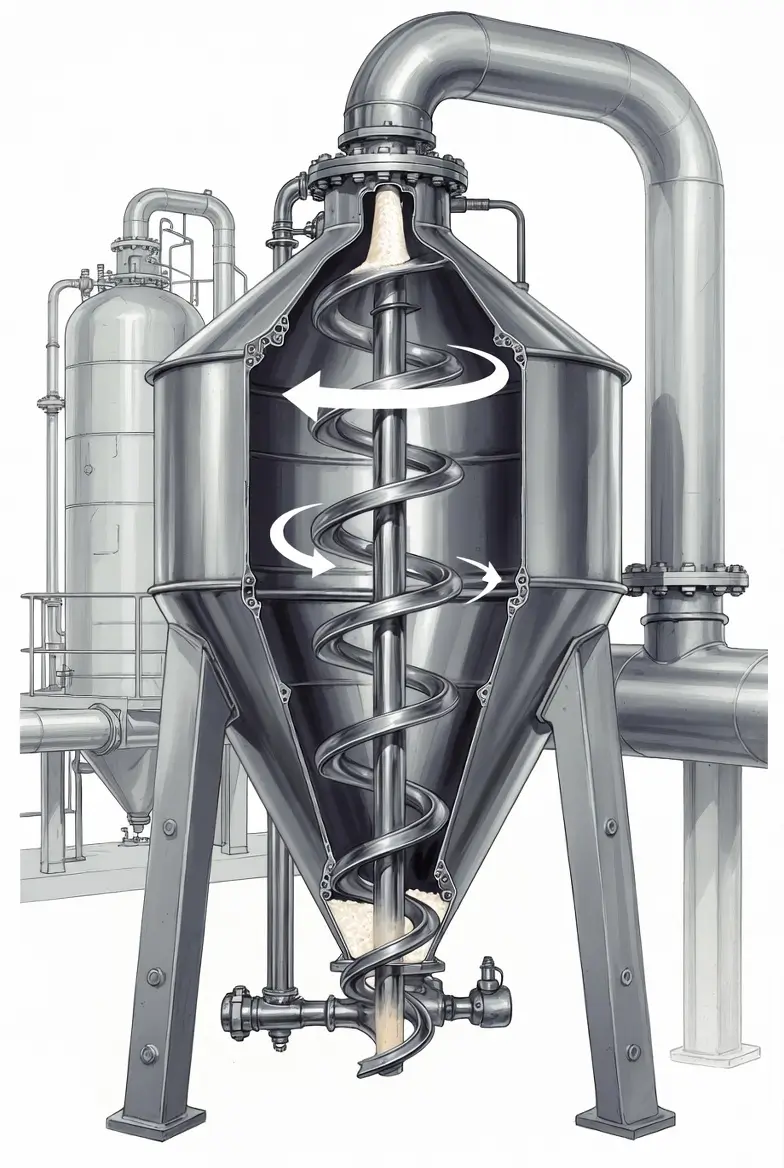
In chemical plants that produce powder products, filtration and drying are among the most critical process steps. Product quality, production efficiency, and operating costs all depend heavily on selecting the right drying equipment.
Conical dryers are widely used because they combine mixing and drying in a single vessel, providing excellent drying performance and product uniformity.
However, equipment selection should not be based on drying performance alone. From an owner’s engineering perspective, maintenance requirements, operator workload, product contamination risks, and plant safety are equally important.
Although I have not worked extensively with conical dryers, I have often considered their practical limitations while evaluating equipment for chemical plants. This article focuses on those limitations from an operational rather than a theoretical perspective.
1. Frequent Piping Changeovers Increase Operator Workload
One of the defining characteristics of a conical dryer is that the vessel itself rotates during operation.
Because of this movement, process piping cannot remain permanently connected. Operators must disconnect and reconnect piping before and after each drying cycle.
While this design improves drying efficiency, it also creates repetitive manual work.
As labor shortages become a growing concern throughout the process industries, minimizing manual operations has become increasingly important. Unfortunately, piping changeovers are difficult to eliminate with this type of equipment.
Large conical dryers also require additional infrastructure such as:
- Access platforms and stairs
- Safe working areas around upper piping connections
- Space for lower discharge connections
- Fall protection and maintenance access
These supporting facilities increase both construction costs and daily operating effort.
2. Increased Risk of Product Contamination
Every time process piping is disconnected, the equipment is temporarily exposed to the surrounding environment.
This creates opportunities for contamination from sources such as:
- Bolts and nuts
- Gasket fragments
- Airborne dust
- Operator-related contamination
Cleanrooms and strict operating procedures can reduce these risks, but many chemical plants do not operate under pharmaceutical-level cleanliness standards.
In some facilities, raw materials are loaded directly from bulk bags, while dried products are discharged into open containers.
These practices make contamination control an important consideration during equipment selection.
Operational procedures should therefore be evaluated alongside drying performance.
3. Rotating Equipment Creates Mechanical Safety Hazards
Unlike many conventional dryers, a conical dryer rotates as a complete unit.
Although rotating parts are generally positioned above operator level, the equipment still presents mechanical hazards during maintenance and operation.
Typical protective measures include:
- Safety fencing
- Interlock systems
- Restricted access during operation
- Standard operating procedures
The level of protection varies significantly from plant to plant.
Rather than viewing the equipment itself as dangerous, engineers should recognize that rotating machinery requires appropriate safeguards throughout its operating life.
4. Dust Explosion Risks Must Be Evaluated
Like many powder-processing systems, conical dryers require careful evaluation of combustible dust hazards.
The drying stage itself is not the only concern.
The transfer of wet cake from filtration equipment into the dryer may also present explosion risks, particularly when residual organic solvents remain in the product.
Safe operation requires evaluation of:
- Combustible dust characteristics
- Solvent vapors
- Potential ignition sources
A comprehensive hazard assessment should therefore include the entire filtration and drying process, not just the dryer itself.
Why Are Conical Dryers Still Widely Used?
Despite these disadvantages, conical dryers remain popular throughout the chemical industry.
Their advantages include:
- Simultaneous mixing and drying
- Excellent product uniformity
- Closed-system operation
- Good suitability for multiproduct manufacturing
In other words, they are not “bad” equipment.
They simply involve operational trade-offs that should be understood before installation.
The best equipment is not necessarily the one with the highest drying performance, but the one that best fits the plant’s operating philosophy, maintenance capability, and long-term production strategy.
Conclusion
Conical dryers offer excellent drying and mixing performance, making them valuable equipment in many powder-processing applications.
However, engineers should also consider practical issues such as piping changeovers, contamination control, mechanical safety, and combustible dust hazards.
Equipment selection should never focus solely on process performance.
Long-term operation, maintainability, worker safety, and product quality are equally important factors in determining whether a conical dryer is the right solution for a particular chemical plant.
About the Author – NEONEEET
A user‑side chemical plant engineer with 20+ years of end‑to‑end experience across design → production → maintenance → corporate planning. Sharing practical, experience‑based knowledge from real batch‑plant operations. → View full profile



Comments